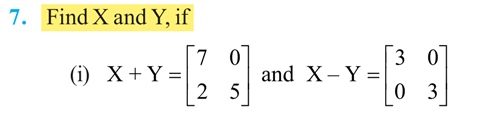
If \( A+B=\begin{bmatrix}7 & 0\\2 & 5\end{bmatrix} \) and \( A-B=\begin{bmatrix}3 & 0\\0 & 3\end{bmatrix} \), then
Answer & explanation
Correct answer: option 1
The correct answer is Option (1) → \( A=\begin{bmatrix}5 & 0\\1 & 4\end{bmatrix},B=\begin{bmatrix}2 & 0\\1 & 1\end{bmatrix} \)
Adding the two equations gives 2A, and subtracting them gives 2B:
\( \displaystyle 2A=\begin{bmatrix}7 & 0\\2 & 5\end{bmatrix}+\begin{bmatrix}3 & 0\\0 & 3\end{bmatrix} \)
\( \displaystyle =\begin{bmatrix}10 & 0\\2 & 8\end{bmatrix} \)
\( \displaystyle A=\begin{bmatrix}5 & 0\\1 & 4\end{bmatrix} \)
\( \displaystyle 2B=\begin{bmatrix}7 & 0\\2 & 5\end{bmatrix}-\begin{bmatrix}3 & 0\\0 & 3\end{bmatrix} \)
\( \displaystyle =\begin{bmatrix}4 & 0\\2 & 2\end{bmatrix} \)
\( \displaystyle B=\begin{bmatrix}2 & 0\\1 & 1\end{bmatrix} \)
Why the other options are incorrect
Option (2) \( A=\begin{bmatrix}2 & 0\\1 & 1\end{bmatrix},B=\begin{bmatrix}5 & 0\\1 & 4\end{bmatrix} \) — Incorrect. A and B are interchanged; with these matrices A − B would be \( \begin{bmatrix}-3 & 0\\0 & -3\end{bmatrix} \).
Option (3) \( A=\begin{bmatrix}10 & 0\\2 & 8\end{bmatrix},B=\begin{bmatrix}4 & 0\\2 & 2\end{bmatrix} \) — Incorrect. These are 2A and 2B; they have not been divided by 2.
Option (4) \( A=\begin{bmatrix}4 & 0\\2 & 2\end{bmatrix},B=\begin{bmatrix}10 & 0\\2 & 8\end{bmatrix} \) — Incorrect. These are 2B and 2A, not divided by 2 and also interchanged.
NCERT (2026-27 edition):
Operations on Matrices