2N2O5 (g) → 4NO2 (g) + O2 (g)
The value of rate constant (k) for the above reaction was determined at several temperatures. A plot of ln k versus 1/T gave a straight line with slope –1.2 × 10⁴ K. The activation energy of the reaction will be
Answer & explanation
Correct answer: option 1
The correct answer is Option (1) → 9.9 × 10⁴ J mol-1
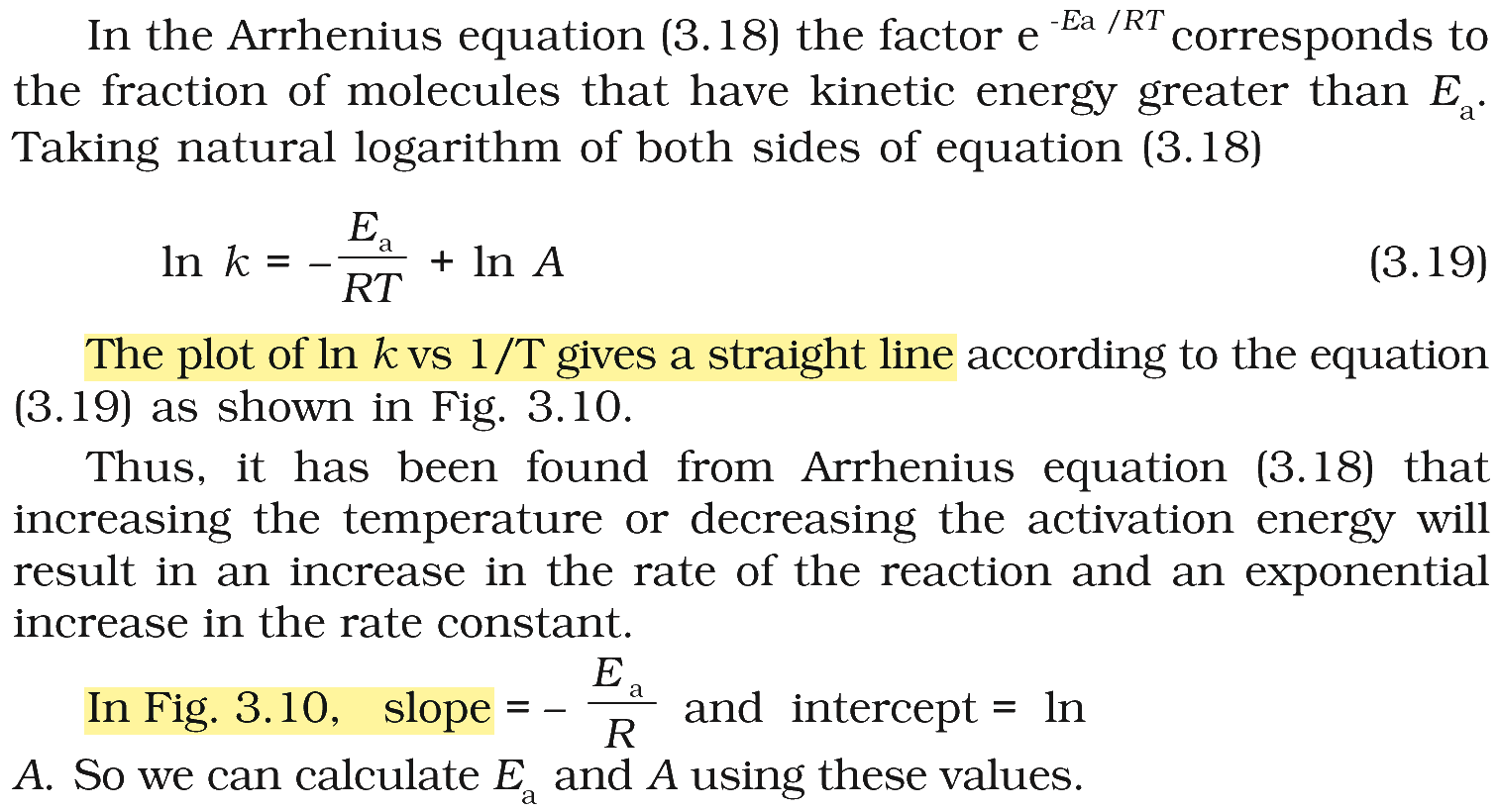
The Arrhenius equation gives the dependence of the rate constant on temperature. Taking natural logarithms turns it into the equation of a straight line:
\( \displaystyle k=A\,e^{-E_a/RT} \)
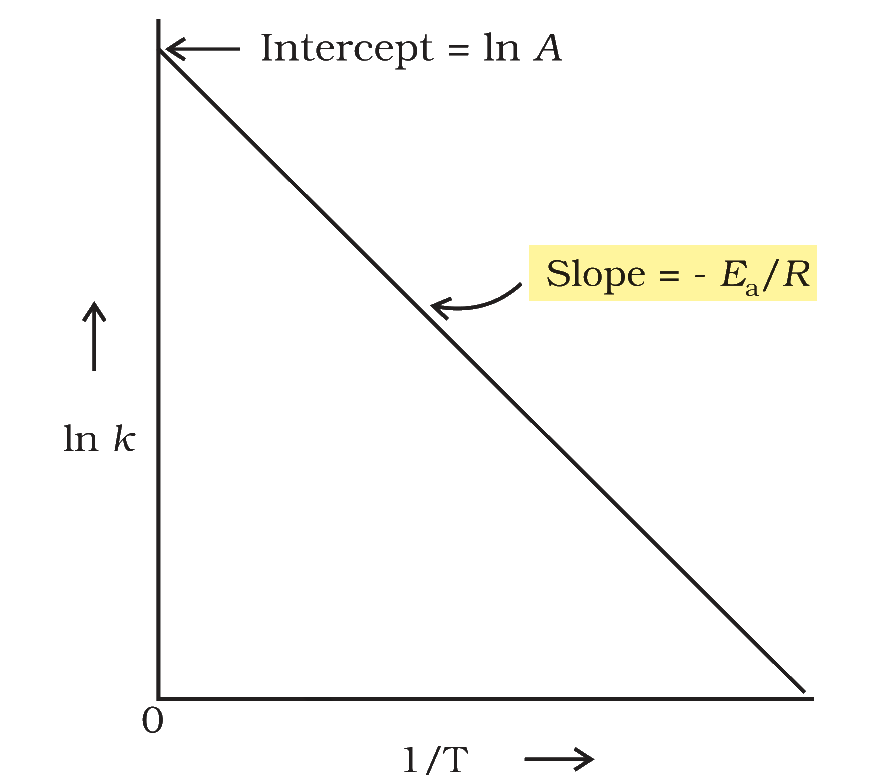
\( \displaystyle \ln k=\ln A-\frac{E_a}{R}\times\frac{1}{T} \)
So a plot of ln k against 1/T is a straight line with slope = −Ea/R, and the activation energy is found from the slope.
\( \displaystyle -\frac{E_a}{R}=-1.2\times10^{4}\ \mathrm{K} \)
\( \displaystyle E_a=1.2\times10^{4}\times8.314 \)
\( \displaystyle E_a=9.98\times10^{4}\ \mathrm{J\,mol^{-1}} \)
So the activation energy is about 9.9 × 10⁴ J mol−1.
NCERT (2026-27 edition):
Temperature Dependence of the Rate of a Reaction – …