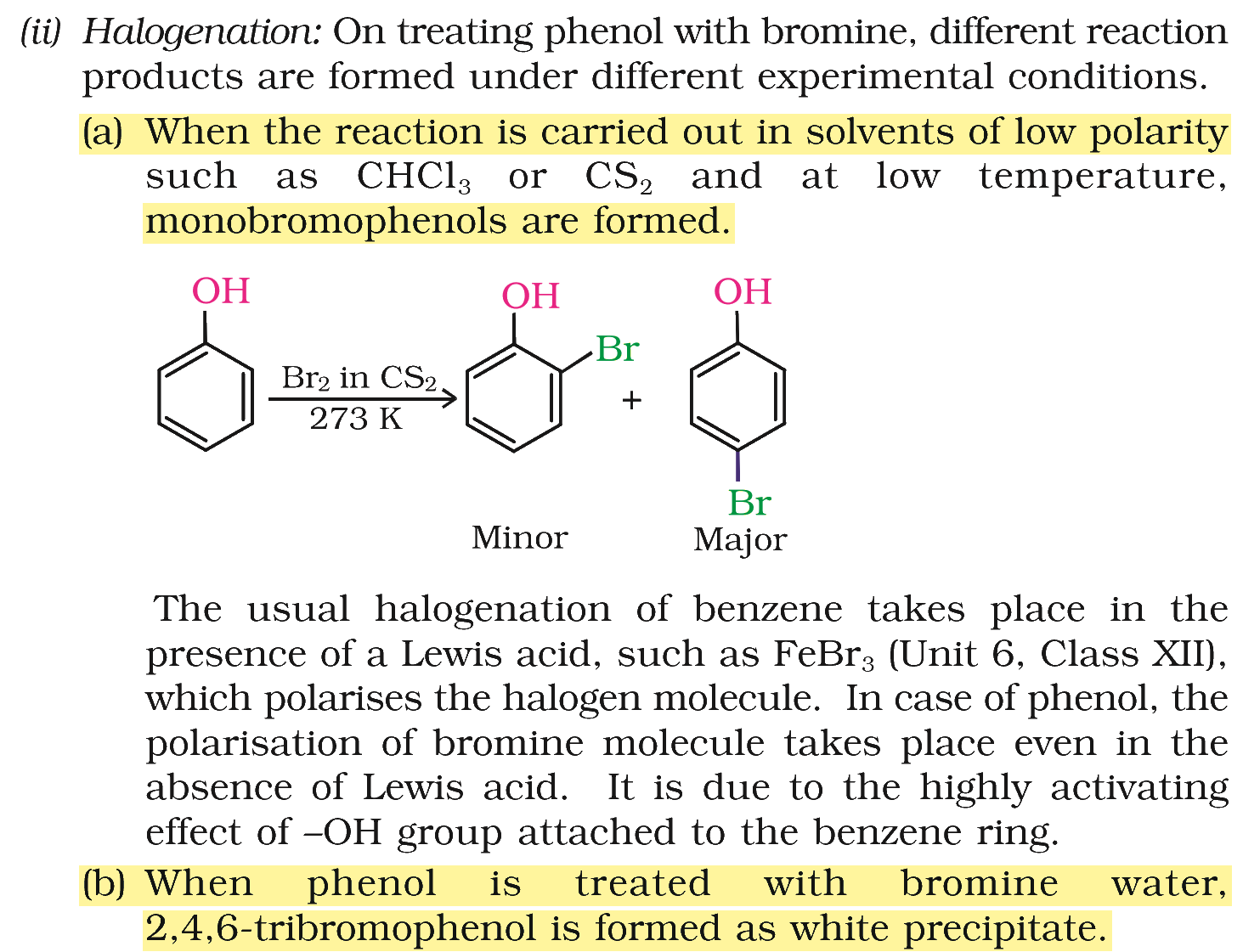
The product(s) formed when phenol reacts with Br2 in CS2 at low temperature is
Answer & explanation
Correct answer: option 2
The correct answer is Option (2) → o- and p- bromophenol
The –OH group of phenol releases electrons into the ring by resonance. This makes the ring very reactive and directs incoming electrophiles to the ortho and para positions. The product of bromination depends on the solvent:
Solvent of low polarity (CHCl3 or CS2) at low temperature: bromine is not strongly polarised, so only one bromine enters the ring. A mixture of o-bromophenol and p-bromophenol forms (the para isomer is the major product).
\( \displaystyle \ce{C6H5OH + Br2} \xrightarrow[\text{273 K}]{\ce{CS2}} \text{o- and p-bromophenol} + \ce{HBr} \)
Bromine water: phenol reacts completely and a white precipitate of 2,4,6-tribromophenol forms.
\( \displaystyle \ce{C6H5OH + 3Br2} \xrightarrow{\ce{H2O}} \text{2,4,6-tribromophenol (white ppt.)} + \ce{3HBr} \)
Here the reaction is carried out in \( \ce{CS2} \) at low temperature, so the products are o- and p-bromophenol.
Why the other options are incorrect
Option (1) m- bromophenol — Incorrect. The –OH group is ortho/para directing, so meta substitution does not occur.
Option (3) p- bromophenol — Incorrect. It is the major product, but the ortho isomer also forms, so it is not the complete answer.
Option (4) 2,4,6-tribromophenol — Incorrect. It forms with bromine water, where the polar solvent makes bromination much faster.
NCERT (2026-27 edition):
Halogenation