If E and F are independent events associated with an experiment, then which one of the following statements is correct?
Answer & explanation
Correct answer: option 3
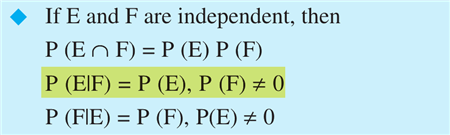
The correct answer is Option (3) → \(P(E|F) = P(E)\)
For independent events, \(P(E \cap F) = P(E)P(F)\). So, by the definition of conditional probability (with \(P(F) \ne 0\)),
\(\displaystyle P(E|F) = \frac{P(E \cap F)}{P(F)} = \frac{P(E)P(F)}{P(F)} = P(E)\)
Why the other options are incorrect
Option (1) \(P(E \cap F) = 0\) — Incorrect. This holds for mutually exclusive events. For independent events \(P(E \cap F) = P(E)P(F)\), which is not 0 unless P(E) or P(F) is 0.
Option (2) \(P(E \cup F) = 1\) — Incorrect. \(P(E \cup F) = P(E) + P(F) - P(E)P(F)\); for example, \(P(E) = P(F) = \frac{1}{2}\) gives \(\frac{3}{4}\).
Option (4) \(P(E|F) = P(F)\) — Incorrect. \(P(E|F) = P(E)\), which equals P(F) only when P(E) = P(F).
NCERT (2026-27 edition):
Probability