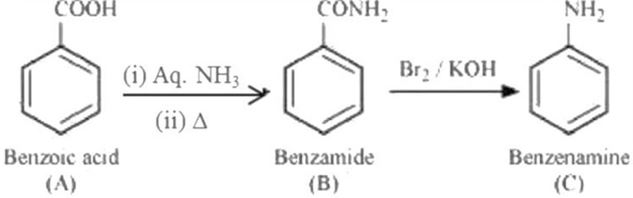
An aromatic compound 'X' on treatment with aqueous ammonia and heating forms the compound 'Y' which on heating with $Br_2$ and KOH forms a compound 'Z' of the molecular formula $C_6H_7N$. The structures of X, Y and Z can be
Answer & explanation
Correct answer: option 1
The correct answer is Option (1) →
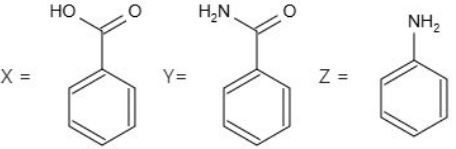
The key reaction mentioned in the question is $Br_2$ / $KOH$, which is characteristic of the Hofmann bromamide reaction.
In this reaction, amides on treatment with $Br_2$ and $KOH$ form primary amines with one carbon less.
General reaction:
$RCONH_2 + Br_2 + 4KOH \rightarrow RNH_2 + 2KBr + K_2CO_3 + 2H_2O$
Thus, compound Y must be an amide, and the product Z must be an amine.
The molecular formula of Z is $C_6H_7N$, which corresponds to aniline ($C_6H_5NH_2$).
Therefore:
Z = Aniline
Step 1: Formation of Y
When benzoic acid reacts with aqueous ammonia and heating, it first forms ammonium benzoate, which on heating converts to benzamide.
Reaction:
$C_6H_5COOH + NH_3 \longrightarrow C_6H_5CONH_2 + H_2O$$
Thus:
Y = Benzamide
Step 2: Hofmann Bromamide Reaction
Benzamide reacts with $Br_2$ / $KOH$ to give aniline.
Reaction:
$C_6H_5CONH_2 \rightarrow C_6H_5NH_2$
Thus:
Z = Aniline
Summary
- X = Benzoic acid
- Y = Benzamide
- Z = Aniline