Match List-I with List-II:
| List-I Conservation of Vijayanagara | List-II Year | ||
| (A) | Colin Mackenzie visits Vijayanagara | (I) | 1856 |
| (B) | Alexander Greenlaw takes the first detailed photographs of archaeological remains at Hampi | (II) | 1902 |
| (C) | J.F. Fleet begins documenting the inscriptions on the temple walls at the site | (III) | 1800 |
| (D) | Conservation begins under John Marshall | (IV) | 1876 |
Choose the correct answer from the options given below:
Answer & explanation
Correct answer: option 1
The correct answer is Option (1) → (A)-(III), (B)-(I), (C)-(IV), (D)-(II)
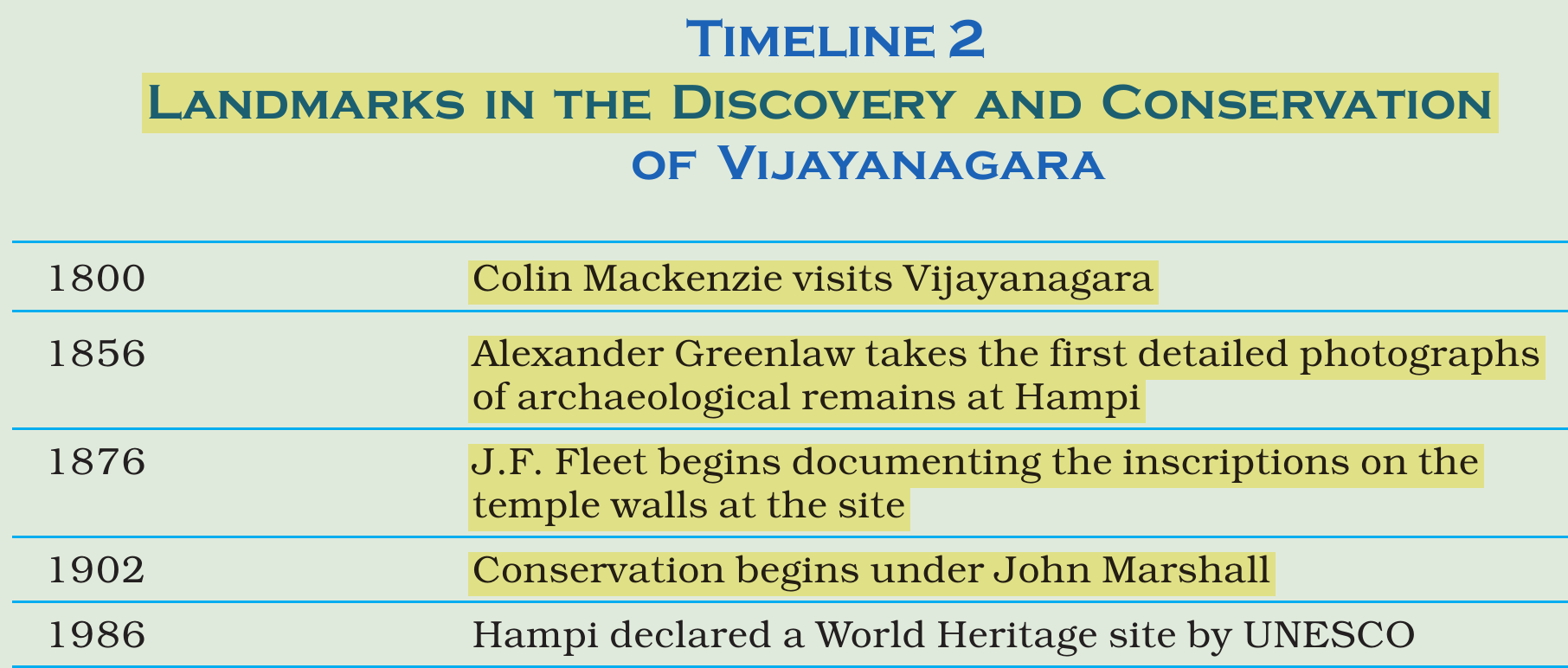
(A) Colin Mackenzie visits Vijayanagara — this matches (III) 1800. Colonel Colin Mackenzie, an engineer and antiquarian of the East India Company, brought the ruins at Hampi to light and prepared the first survey map of the site.
(B) Alexander Greenlaw takes the first detailed photographs of archaeological remains at Hampi — this matches (I) 1856. From 1856 photographers began to record the monuments, which helped scholars to study them.
(C) J.F. Fleet begins documenting the inscriptions on the temple walls at the site — this matches (IV) 1876. His work added to the collection of inscriptions that epigraphists had begun at Hampi from 1836.
(D) Conservation begins under John Marshall — this matches (II) 1902. Marshall began the conservation of the site early in the twentieth century; in 1986 Hampi was declared a World Heritage site.
NCERT: Themes in Indian History Part II — Chapter 7: An Imperial Capital: Vijayanagara (2026-27)
|