
Ethers are class of organic compounds that contain ether group – an oxygen atom connected to two alkyl groups or aryl groups. They have the general formula R – O – R′, where R and R′ represents the alkyl or aryl groups. Ether, like water have a tetrahedral geometry i.e., oxygen is sp3 hybridised. The C – O – C bond angle in ethers is slightly greater than the tetrahedral angle due to repulsive interactions between the two bulky groups when they are attached to oxygen.
Answer & explanation
Correct answer: option 2
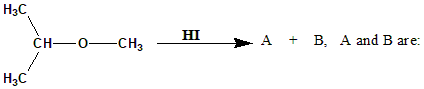
The correct answer is Option (2) → \((CH_3)_2CH{-}OH + CH_3I\)
Ethers are cleaved by concentrated HI. The ether oxygen is first protonated:
\( \displaystyle \ce{(CH3)2CH-O-CH3 + HI -> (CH3)2CH-O^+(H)-CH3 + I-} \)
Here the methyl carbon is less hindered than the isopropyl carbon, so \( \ce{I^{-}} \) attacks the \( \ce{CH3} \) group:
\( \displaystyle \ce{I- + CH3-O^+(H)-CH(CH3)2 -> CH3I + (CH3)2CHOH} \)
So A and B are propan-2-ol and iodomethane.
Why the other options are incorrect
Option (1) \((CH_3)_2CH{-}I + CH_3OH\) — Incorrect. This needs \( \ce{I^{-}} \) to attack the more hindered secondary carbon; that happens only when one group is tertiary (SN1).
Option (3) \((CH_3)_3C{-}OH\) — Incorrect. Tert-butyl alcohol has four carbons arranged differently; it cannot come from an isopropyl methyl ether.
Option (4) \(CH_3OH + CH_3I\) — Incorrect. These would come from dimethyl ether, \( \ce{CH3-O-CH3} \); the isopropyl group would be lost.
NCERT (2026-27 edition):
Chemical Reactions – “… Iodide is a good nucleophile. It attacks the least substituted carbon of the oxonium ion … and displaces an alcohol molecule by SN2 mechanism. Thus, in the cleavage of mixed ethers with two different alkyl groups, the alcohol and alkyl iodide formed, depend on the nature of alkyl groups. When primary or secondary alkyl groups are present, it is the lower alkyl group that forms alkyl iodide (SN2 reaction).”