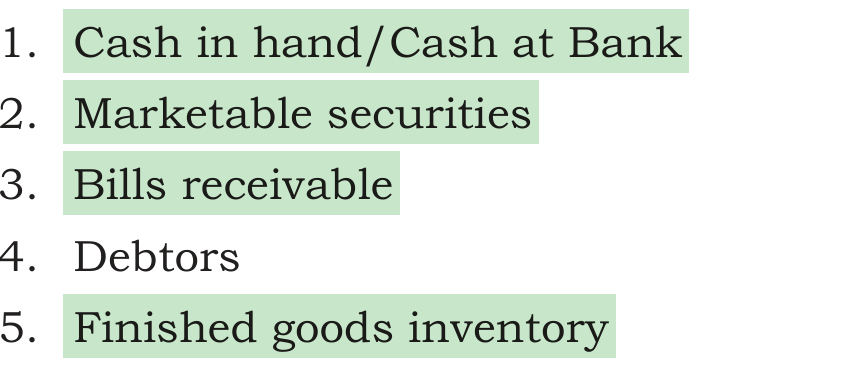
Current assets are usually more liquid but contribute less to the profits than fixed assets. Examples of current assets are:
(A) Cash in hand/Cash at the Bank
(B) Marketable securities
(C) Bills receivable
(D) Finished goods inventory
Choose the correct answer from the options given below:
Answer & explanation
Correct answer: option 3
The correct answer is Option (3) → (A), (B), (C) and (D)
Current assets are assets that can be turned into cash within a short time. The usual list of current assets, in order of liquidity (how easily they become cash): cash in hand/cash at bank, marketable securities, bills receivable, debtors, finished goods inventory, and so on.
(A) Cash in hand/Cash at the Bank — A current asset (Correct). Cash is the most liquid asset. It is first in the order of liquidity.
(B) Marketable securities — A current asset (Correct). These are short-term investments that can be sold quickly for cash.
(C) Bills receivable — A current asset (Correct). These are bills that customers will pay to the firm in a short time.
(D) Finished goods inventory — A current asset (Correct). These are goods ready for sale. They become cash when they are sold.
NCERT (2026-27 Edition): “Working Capital Apart from the investment in fixed assets every business organisation needs to invest in current assets. This investment facilitates smooth day-to-day operations of the business. Current assets are usually more liquid but contribute less to the profits than fixed assets. Examples of current assets, in order of their liquidity, are as under.”
|