Match List-I with List-II
| List I | List II |
| Chemical name | Chemical formula |
| (A) Adipic acid | (I) 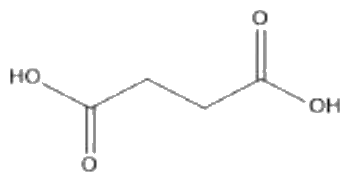 |
| (B) Succinic acid | (II) 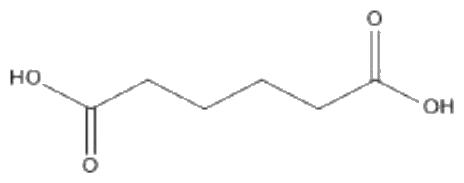 |
| (C) Glutaric acid | (III) 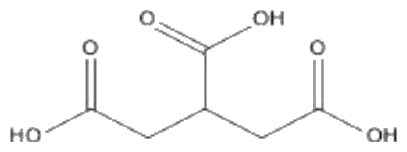 |
| (D) Carballylic acid | (IV) 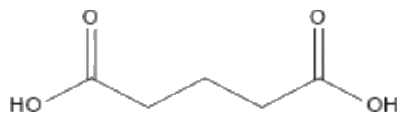 |
Answer & explanation
Correct answer: option 2
The correct answer is Option (2) → (A) - (II), (B) - (I), (C) - (IV), (D) - (III)
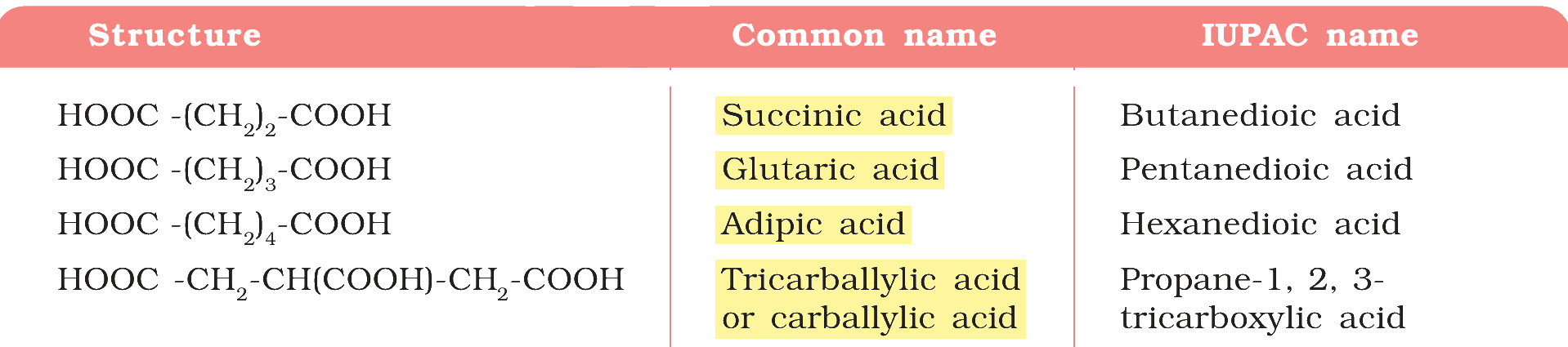
The common names of the straight-chain dicarboxylic acids, \( \ce{HOOC-(CH2)} \)n–COOH, depend on the number of \( \ce{CH2} \) groups between the two –COOH groups:
n = 0 oxalic, n = 1 malonic, n = 2 succinic, n = 3 glutaric, n = 4 adipic (\( \ce{C2} \) to \( \ce{C6} \) acids).
Carballylic acid is different: it is a tricarboxylic acid, propane-1,2,3-tricarboxylic acid. So count the –COOH groups first, then the \( \ce{CH2} \) groups in each structure.
(A) Adipic acid — This matches structure II. It has four \( \ce{CH2} \) groups between the two –COOH groups (hexanedioic acid).
\( \displaystyle \ce{HOOC-(CH2)4-COOH} \)
(B) Succinic acid — This matches structure I. It has two \( \ce{CH2} \) groups (butanedioic acid).
\( \displaystyle \ce{HOOC-(CH2)2-COOH} \)
(C) Glutaric acid — This matches structure IV. It has three \( \ce{CH2} \) groups (pentanedioic acid).
\( \displaystyle \ce{HOOC-(CH2)3-COOH} \)
(D) Carballylic acid — This matches structure III, the only structure with three –COOH groups (propane-1,2,3-tricarboxylic acid).
\( \displaystyle \ce{HOOC-CH2-CH(COOH)-CH2-COOH} \)
Shortcut: The tricarboxylic acid is easy to spot: (D)–(III) appears only in Options (2) and (4), and (A)–(II) then leaves only Option (2).
NCERT (2026-27 edition):
Nomenclature – …