
CUETMOCK
  • Pricing
  • Mentors
Log inStart freeStart free mocks→

First test, then trust

Try a free CUET mock test.

Join 5,00,000+ students who rehearsed exam day on the exact NTA screen before sitting CUET. On the web and on Android.

Start free mocks →Get the Android app
CUETMOCK

India's #1 CUET Mock Test Platform. Original NCERT-based questions on the exact NTA exam screen — trusted by 5,00,000+ students since CUET 2022.

Get it onGoogle PlayScan to download the CUETMOCK app

Mock tests

  • CUET mock test series
  • Commerce mocks
  • Humanities (Arts) mocks
  • Science mocks
  • Languages & GAT mocks
  • Free practice questions
  • Pricing

Resources

  • CUET exam guide
  • CUET syllabus
  • Universities accepting CUET
  • Expert blogs
  • News & notifications
  • Webinars & counselling
  • CUET score calculator
  • How we estimate your rank
  • FAQs

Company

  • About us
  • Our leadership & team
  • Our toppers
  • Mentors
  • For schools
  • Contact us
  • Terms
  • Privacy
  • Refund policy

Talk to us

+91 7696 6630 56info@cuetmock.comWhatsApp us

Our other platforms

  • JEE Mock — For IIT-JEE aspirants
  • NEET Mock — For NEET aspirants

Newsletter

Exam updates, study material and offers — no spam.

© 2026 NYC Ventures Pvt. Ltd.

701-702, Royal Business Park, Zirakpur, Punjab - 140603

  • Terms of use
  • Privacy policy
  • Refund policy
  • Contact us

iCUETMOCK is an independent preparation platform, not affiliated with the National Testing Agency (NTA). Always check exam details on the official NTA website.

  • Home
  • Mock tests
  • CUET guide
  • Pricing
  • Log in
Home/Practice questions/Chemistry
ChemistryPhysical: Electro Chemistry

The figure shows the corrosion of iron in the atmosphere.Iron at the…

The figure shows the corrosion of iron in the atmosphere.
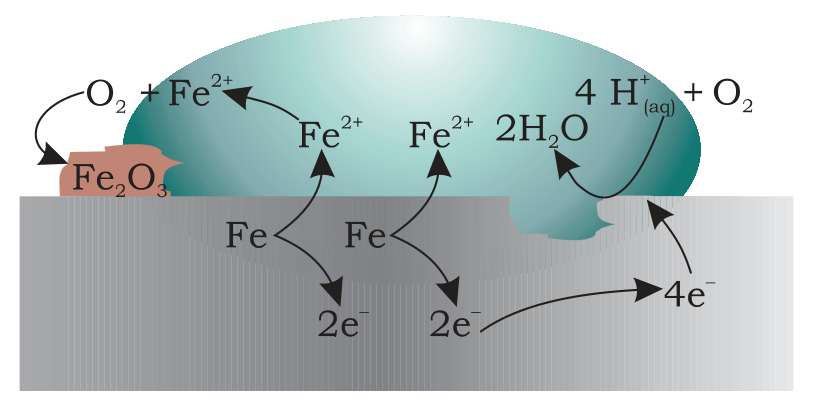
Corrosion of iron in atmosphere

Iron at the spots marked ‘Fe’ under the water drop gives the species shown by the arrows. What do these spots act as, and what takes place there?

Answer & explanation+

Correct answer: option 1

The correct answer is Option (1) → Anode; iron is oxidised to Fe2+ ions, releasing electrons

The arrows in the figure show iron at these spots giving Fe2+ ions and electrons (2e−). Loss of electrons is oxidation, and the spot at which oxidation takes place behaves as the anode. The electrons released here move through the metal to another spot, where oxygen is reduced.

    Anode: \( \ce{2Fe(s) -> 2Fe^2+ + 4e^-} \)

Why the other options are incorrect

Option (2) Cathode; oxygen is reduced to water — Incorrect. Oxygen is reduced to water at another spot, at the right of the drop, which receives the 4e− through the metal; that spot is the cathode, not the spots marked Fe.

Option (3) Cathode; Fe2+ ions take up electrons and are deposited as iron — Incorrect. The arrows run from Fe to Fe2+ and 2e−: iron passes into the drop and gives up electrons; it does not take them up.

Option (4) Anode; Fe2+ ions are oxidised by oxygen to Fe2O3 — Incorrect. The spots are anodic, but the change there is Fe → Fe2+. The Fe2+ ions are oxidised by atmospheric oxygen to rust (Fe2O3) later, at the left edge of the drop.

NCERT (2026-27 edition):
2.8 Corrosion – “In corrosion, a metal is oxidised by loss of electrons to oxygen and formation of oxides. …The chemistry of corrosion is quite complex but it may be considered essentially as an electrochemical phenomenon. At a particular spot (Fig. 2.13) of an object made of iron, oxidation takes place and that spot behaves as anode and we can write the reaction”

    Anode: 2 Fe (s) → 2 Fe2+ + 4 e–    Eo(Fe2+/Fe) = – 0.44 V

“Electrons released at anodic spot move through the metal and go to another spot on the metal and reduce oxygen in the presence of H+ … This spot behaves as cathode with the reaction”

    Cathode: O2(g) + 4 H+(aq) + 4 e– → 2 H2O (l)

“…The ferrous ions are further oxidised by atmospheric oxygen to ferric ions which come out as rust in the form of hydrated ferric oxide (Fe2O3. x H2O) and with further production of hydrogen ions.”

Fig. 2.13

Fig. 2.13: Corrosion of iron in atmosphere

Advertisement

Practise more on Physical: Electro Chemistry

Chapter-wise mocks on the real NTA exam screen, with solutions and your rank. Your first mocks are free.

Start free mocks →

Advertisement

Next questions

  1. What happens when cyclohexanone reacts with isopropyl alcohol in the presence of aluminium isopropoxide?Chemistry · Organic: Aldehydes, Ketones and Carboxylic Acids
  2. There has been rapid growth in the gross domestic product, but without simultaneous increase in employment opportunities. This is known as…Economics · Indian Economic Development: Employment - Growth, Informalisation and Other Issues
  3. Chemistry · Inorganic: D and F Block Elements
  4. Which of the following is NOT a function of SEBI?Business Studies · Financial Markets
  5. The average of the ages of Sonu, Hari and Govind is 30 years. If their ages are in the ratio of 4 : 5 : 6, respectively, then the differenc…General Aptitude Test · General Ability
  6. According to the National Human Rights Commission (NHRC) Act, 1993, who amongst the following can be its chairman?General Aptitude Test · General Knowledge
  7. Match the items in Column-I and Column-II Column I Column II (A) Soda Water (i) A solution of gas in solid (B) Sugar solution (ii) A soluti…Chemistry · Physical: Solutions
  8. When did the rise of parties representing OBC interests first gain political expression at the national level?1) 1950s2) 19773) 1990s4) 200…Political Science · Politics in India Since Independence: Recent Developments in Indian Politics
  9. In programmed instruction, information is broken into meaningful units, and these units are arranged in a proper way, from simple to comple…Business Studies · Staffing
  10. A can do a piece of work alone in 12 days. B is 20% more efficient than A, and C is 25% more efficient than B. In how many days can B and C…General Aptitude Test · Numerical Ability