
A ball is thrown upwards from the plane surface of the ground. Suppose the plane surface from which the ball is thrown also consists of the points A(1, 0, 2), B(3, −1, 1) and C(1, 2, 1) on it. The highest point the ball reaches is D(2, 3, 1) as shown in the figure. Using this information answer the question.
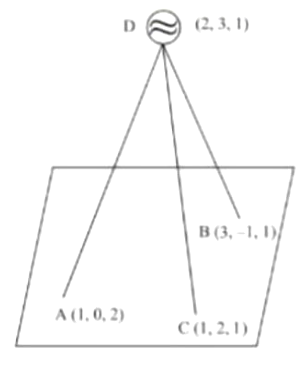
The area of ΔABC is:
Answer & explanation
Correct answer: option 4
The correct answer is Option (4) → \(\displaystyle\frac{1}{2}\sqrt{29}\) sq. units
The area of a triangle is half the magnitude of the cross product of two of its sides. Taking the sides from C:
\(\vec{CA} = (1 - 1)\hat{\imath} + (0 - 2)\hat{\jmath} + (2 - 1)\hat{k} = -2\hat{\jmath} + \hat{k}\)
\(\vec{CB} = (3 - 1)\hat{\imath} + (-1 - 2)\hat{\jmath} + (1 - 1)\hat{k} = 2\hat{\imath} - 3\hat{\jmath}\)
\( \displaystyle \vec{CA} \times \vec{CB} = \begin{vmatrix}\hat{\imath} & \hat{\jmath} & \hat{k}\\0 & -2 & 1\\2 & -3 & 0\end{vmatrix} \)
\(= \hat{\imath}(0 + 3) - \hat{\jmath}(0 - 2) + \hat{k}(0 + 4)\)
\(= 3\hat{\imath} + 2\hat{\jmath} + 4\hat{k}\)
\( \displaystyle \left|\vec{CA} \times \vec{CB}\right| = \sqrt{9 + 4 + 16} = \sqrt{29} \)
So
\( \displaystyle \text{Area of } \Delta ABC = \frac{1}{2}\sqrt{29} \text{ sq. units} \)