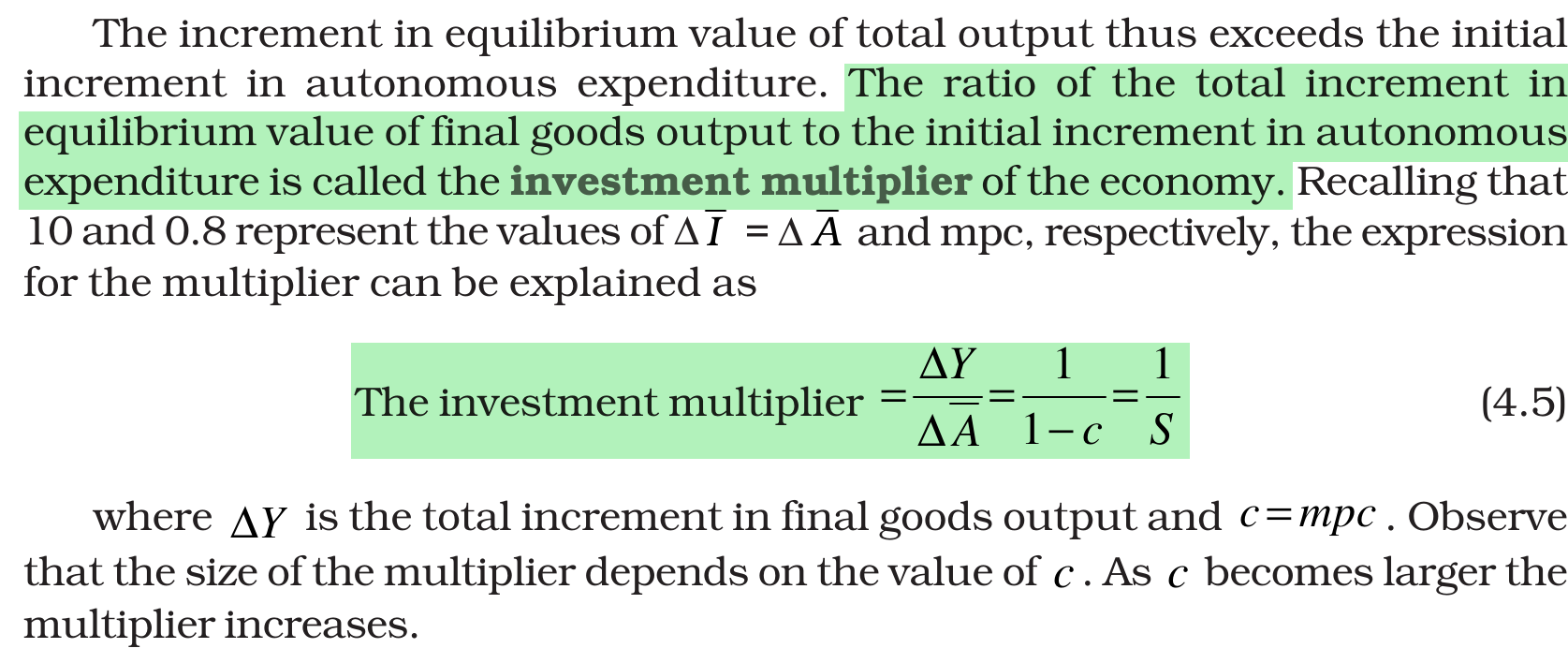
The ratio of the total increment in equilibrium value of final goods to the initial increment in autonomous expenditure is called ______.
Answer & explanation
Correct answer: option 3
The correct answer is Option (3) → Investment Multiplier
The total rise in equilibrium output divided by the first rise in autonomous spending is the investment multiplier. Autonomous spending is spending that does not depend on income.
Suppose firms spend Rs. 10 crore more on investment. That money becomes someone’s income. Part of it is spent and becomes another person’s income, round after round. So output rises by more than the first Rs. 10 crore.
Investment multiplier = ΔY/ΔA = 1/(1 − c)
Here c is the marginal propensity to consume, the part of extra income that is spent. If c = 0.8, the multiplier is 5, and the Rs. 10 crore raises output by Rs. 50 crore.
Option (1) Paradox of Thrift — Incorrect. It says that if all people try to save more, total saving does not rise; it falls or stays the same. It is a result about saving, not a ratio.
Option (2) Multiplier Mechanism — Incorrect. This is the process of spending round after round described above. The ratio this process produces is called the investment multiplier.
Option (3) Investment Multiplier — Correct. It compares the total rise in output with the first rise in autonomous spending.
Option (4) Money Multiplier — Incorrect. It shows how bank lending turns a first deposit into total deposits many times larger. It belongs to money and banking.
Note: A same/similar question was asked in CUET (UG) in the papers below.
| 2026 | 2025 | 2024 | 2023 | 2022 |
| 13-05 S1* 21-05 S1* | 13-05 S2* 27-05 S2* 29-05 S2* 30-05 S2* | – | 29-05 S1 22-06 S3* | – |
* A similar question.
NCERT (2026-27): Introductory Macroeconomics — Chapter 4: Determination of Income and Employment
|