CUETMOCK
  • Pricing
  • Mentors
Log inStart freeStart free mocks→

First test, then trust

Try a free CUET mock test.

Join 5,00,000+ students who rehearsed exam day on the exact NTA screen before sitting CUET. On the web and on Android.

Start free mocks →Get the Android app
CUETMOCK

India's #1 CUET Mock Test Platform. Original NCERT-based questions on the exact NTA exam screen — trusted by 5,00,000+ students since CUET 2022.

Get it onGoogle PlayScan to download the CUETMOCK app

Mock tests

  • CUET mock test series
  • Browse all papers
  • Commerce mocks
  • Humanities (Arts) mocks
  • Science mocks
  • Languages & GAT mocks
  • Free practice questions
  • Pricing

Resources

  • CUET exam guide
  • CUET syllabus
  • Universities accepting CUET
  • Expert blogs
  • News & notifications
  • Webinars & counselling
  • CUET score calculator
  • How we estimate your rank
  • FAQs

Company

  • About us
  • Our leadership & team
  • Our toppers
  • Mentors
  • For schools
  • Contact us
  • Terms
  • Privacy
  • Refund policy

Talk to us

+91 7696 6630 56info@cuetmock.comWhatsApp us

Our other platforms

  • JEE Mock — For IIT-JEE aspirants
  • NEET Mock — For NEET aspirants

Newsletter

Exam updates, study material and offers — no spam.

© 2026 NYC Ventures Pvt. Ltd.

701-702, Royal Business Park, Zirakpur, Punjab - 140603

  • Terms of use
  • Privacy policy
  • Refund policy
  • Contact us

iCUETMOCK is an independent preparation platform, not affiliated with the National Testing Agency (NTA). Always check exam details on the official NTA website.

  • Home
  • Mock tests
  • CUET guide
  • Pricing
  • Log in
Home/Practice questions/History
HistoryMedieval India: Peasants, Zamindars and the State

Who is the author of 'Akbarnama'?

Who is the author of 'Akbarnama'?

Answer & explanation+

Correct answer: option 3

The correct answer is Option (3) → Abu'l Fazl

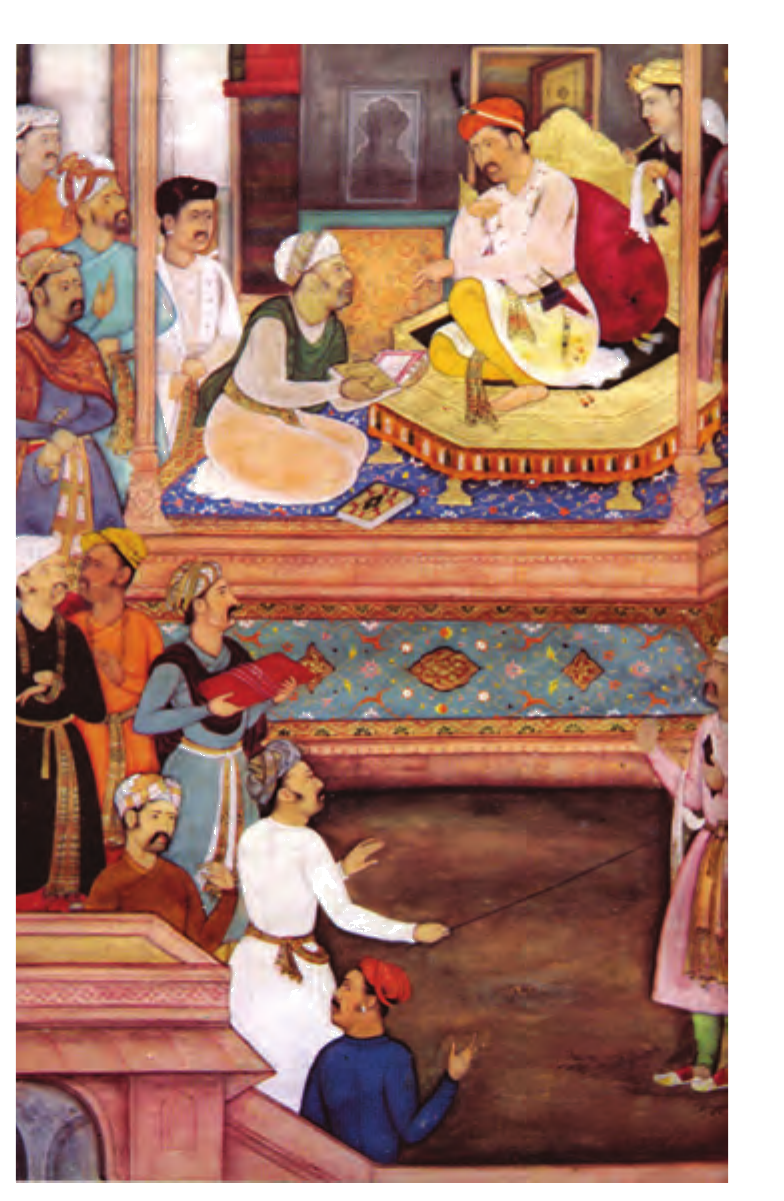
Abu’l Fazl wrote the Akbar Nama, the history of Akbar’s reign commissioned by the emperor; its third book is the Ain-i Akbari.


NCERT (2026-27): “8. The Ain-i Akbari of Abu’l Fazl Allami … The Ain-i Akbari was the culmination of a large historical, administrative project of classification undertaken by Abu’l Fazl at the order of Emperor Akbar. It was completed in 1598, the forty-second regnal year of the emperor, after having gone through five revisions. The Ain was part of a larger project of history writing commissioned by Akbar. This history, known as the Akbar Nama, comprised three books. The first two provided a historical narrative. We will look at these parts more closely in Chapter 9. The Ain-i Akbari, the third book, was organised as a compendium of imperial regulations and a gazetteer of the empire.…”

NCERT extract

Fig. 8.14 Abu’l Fazl presenting the manuscript of the completed Akbar Nama to his patron

Advertisement

Practise more on Medieval India: Peasants, Zamindars and the State

Chapter-wise mocks on the real NTA exam screen, with solutions and your rank. Your first mocks are free.

Start free mocks →

Advertisement

Next questions

  1. Match List-I with List-IIList-IList-II(Figures, etc.)(Area/Volume/Diagonal etc.)(A) Surface area of Cube(I) π(R^2-r^2) (B) Volume of Right…General Aptitude Test · Quantitative Reasoning
  2. N is the brother of Y and Y is the sister of B. B is the wife of Z and C is the mother of Y. How Z is related to C?General Aptitude Test · Verbal Reasoning
  3. In a certain code, PLEADING is written as FMHCZDKO. How is SHOULDER written in that code?General Aptitude Test · Verbal Reasoning
  4. In this question a statement is given which is followed by two assumptions numbered I and II. You have to consider the statement and the fo…General Aptitude Test · Verbal Reasoning
  5. Which of the following is correct in respect of Sharia?History · Medieval India: Bhakti Sufi Traditions
  6. What was the main cause of stagnation in the agricultural sector during the colonial period?Economics · Indian Economic Development: Indian Economy on the Eve of Independence
  7. Arrange the following acids in increasing order of their acidic strengths: HCOOH, FCH_2COOH, NO_2CH_2COOH, ClCH_2COOHChemistry · Organic: Aldehydes, Ketones and Carboxylic Acids
  8. Which modern Indian artist, after academic training in the colonial Art School, rejected it to adopt the flat and colourful style of folk p…Fine Arts · The Bengal School and Cultural Nationalism
  9. Assertion: In Periodic markets shopkeepers remain free on most of the days.Reasoning: The periodic markets are held on specified dates and…Geography · Fundamentals of Human Geography: Tertiary and Quaternary Activities
  10. Which of the following statements are correct ?A. Subsidies will reduce inequality between rich and poor farmers.B. Subsidies are given to…Economics · Indian Economic Development: Indian Economy:1950-1990