
CUETMOCK
  • Pricing
  • Mentors
Log inStart freeStart free mocks→

First test, then trust

Try a free CUET mock test.

Join 5,00,000+ students who rehearsed exam day on the exact NTA screen before sitting CUET. On the web and on Android.

Start free mocks →Get the Android app
CUETMOCK

India's #1 CUET Mock Test Platform. Original NCERT-based questions on the exact NTA exam screen — trusted by 5,00,000+ students since CUET 2022.

Get it onGoogle PlayScan to download the CUETMOCK app

Mock tests

  • CUET mock test series
  • Commerce mocks
  • Humanities (Arts) mocks
  • Science mocks
  • Languages & GAT mocks
  • Free practice questions
  • Pricing

Resources

  • CUET exam guide
  • CUET syllabus
  • Universities accepting CUET
  • Expert blogs
  • News & notifications
  • Webinars & counselling
  • CUET score calculator
  • How we estimate your rank
  • FAQs

Company

  • About us
  • Our leadership & team
  • Our toppers
  • Mentors
  • For schools
  • Contact us
  • Terms
  • Privacy
  • Refund policy

Talk to us

+91 7696 6630 56info@cuetmock.comWhatsApp us

Our other platforms

  • JEE Mock — For IIT-JEE aspirants
  • NEET Mock — For NEET aspirants

Newsletter

Exam updates, study material and offers — no spam.

© 2026 NYC Ventures Pvt. Ltd.

701-702, Royal Business Park, Zirakpur, Punjab - 140603

  • Terms of use
  • Privacy policy
  • Refund policy
  • Contact us

iCUETMOCK is an independent preparation platform, not affiliated with the National Testing Agency (NTA). Always check exam details on the official NTA website.

  • Home
  • Mock tests
  • CUET guide
  • Pricing
  • Log in
Home/Practice questions/Chemistry
ChemistryOrganic: Alcohols, Phenols and Ethers

What is the product X of the given reaction?
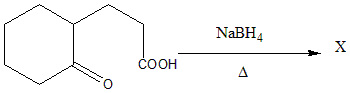
What is the product X of the given reaction?

Answer & explanation+

Correct answer: option 1

The correct answer is Option (1) → 3-(2-hydroxycyclohexyl)propanoic acid

The starting compound, 3-(2-oxocyclohexyl)propanoic acid, has two groups that could be reduced: a ketone C=O in the ring and a carboxyl group at the end of the side chain. Sodium borohydride is a mild reducing agent:

  • Ketone group: reduced by \( \ce{NaBH4} \) to a secondary alcohol: \( \ce{>C=O} \xrightarrow{\ce{NaBH4}} \ce{>CH-OH} \).

  • Carboxyl group: not reduced by \( \ce{NaBH4} \); it stays as –COOH.

So X keeps the three-carbon acid side chain and has an –OH on the ring carbon that carried the C=O: 3-(2-hydroxycyclohexyl)propanoic acid.

Why the other options are incorrect

Option (2) 3-(2-oxocyclohexyl)propanal (ring C=O kept, –COOH changed to –CHO) — Incorrect. It leaves the ketone untouched and changes the carboxyl group, the reverse of what \( \ce{NaBH4} \) does; \( \ce{NaBH4} \) does not reduce –COOH.

Option (3) 2-(2-hydroxyethyl)cyclohexan-1-ol (a diol) — Incorrect. Turning –COOH into an alcohol needs a strong reducing agent such as \( \ce{LiAlH4} \), not \( \ce{NaBH4} \); the side chain shown also has one carbon fewer than in the starting acid.

Option (4) Decalin (two fused rings, no functional group) — Incorrect. Reduction by \( \ce{NaBH4} \) changes a C=O group to CH–OH; it does not remove both functional groups and join the chain into a second ring.

NCERT (2026-27 edition):
8.4 Chemical Reactions – “2. Reduction
(i) Reduction to alcohols: Aldehydes and ketones are reduced to primary and secondary alcohols respectively by sodium borohydride (NaBH4) or lithium aluminium hydride (LiAlH4) as well as by catalytic hydrogenation (Unit 7, Class XII).”

8.9.3 Reactions Involving –COOH Group – “Carboxylic acids are reduced to primary alcohols by lithium aluminium hydride or better with diborane. Diborane does not easily reduce functional groups such as ester, nitro, halo, etc. Sodium borohydride does not reduce the carboxyl group.”

Advertisement

Practise more on Organic: Alcohols, Phenols and Ethers

Chapter-wise mocks on the real NTA exam screen, with solutions and your rank. Your first mocks are free.

Start free mocks →

Advertisement

Next questions

  1. Which pair of salts is expected to give solutions of the same colour when freshly dissolved in water?Chemistry · Inorganic: D and F Block Elements
  2. Select the letter that will replace the question mark (?) in the following series. E, N, U, ?, C, DGeneral Aptitude Test · Verbal Reasoning
  3. What will be the product of the given reaction?Chemistry · Organic: Amines
  4. What happens when two molecules of formaldehyde reacts in the presence of sodium hydroxide?Chemistry · Organic: Aldehydes, Ketones and Carboxylic Acids
  5. Match List I with List IILIST ILIST IIA. Charge on an electronI. 1B. Electric permittivity of free spaceII. 1.6×10^-19 C C. Number of lines…Physics · Electric Charges and Fields
  6. If g(x)=∫fracdxx^1/2+x^1/6 , then g(1)-g(0) is:Maths. Section A · Indefinite Integration (Section A)
  7. The internal length, breadth and height of a cuboidal room are 12 m, 8 m and 10 m,respectively. The total cost (in ₹) of white washing only…General Aptitude Test · Quantitative Reasoning
  8. Which theory advocated by the Muslim League supported the division of India into two separate countries?A) The Two-nation theoryB) The Grea…Political Science · Politics in India Since Independence: Challenges of nation Building
  9. Kumudini Lakhia, the founder of Kadamb School of Dance and Music, is a _________ dancer.General Aptitude Test · General Knowledge
  10. The element that can exhibit the highest number of oxidation states among the following is:Chemistry · Inorganic: D and F Block Elements