Which pair of salts is expected to give solutions of the same colour when freshly dissolved in water?
Answer & explanation
Correct answer: option 1
The correct answer is Option (1) → VOCl2 and CuCl2
In water, a transition metal ion with a partly filled d subshell is coloured; its colour depends on the ion and its dn configuration. So the colour of each solution is that of its aquated metal ion.
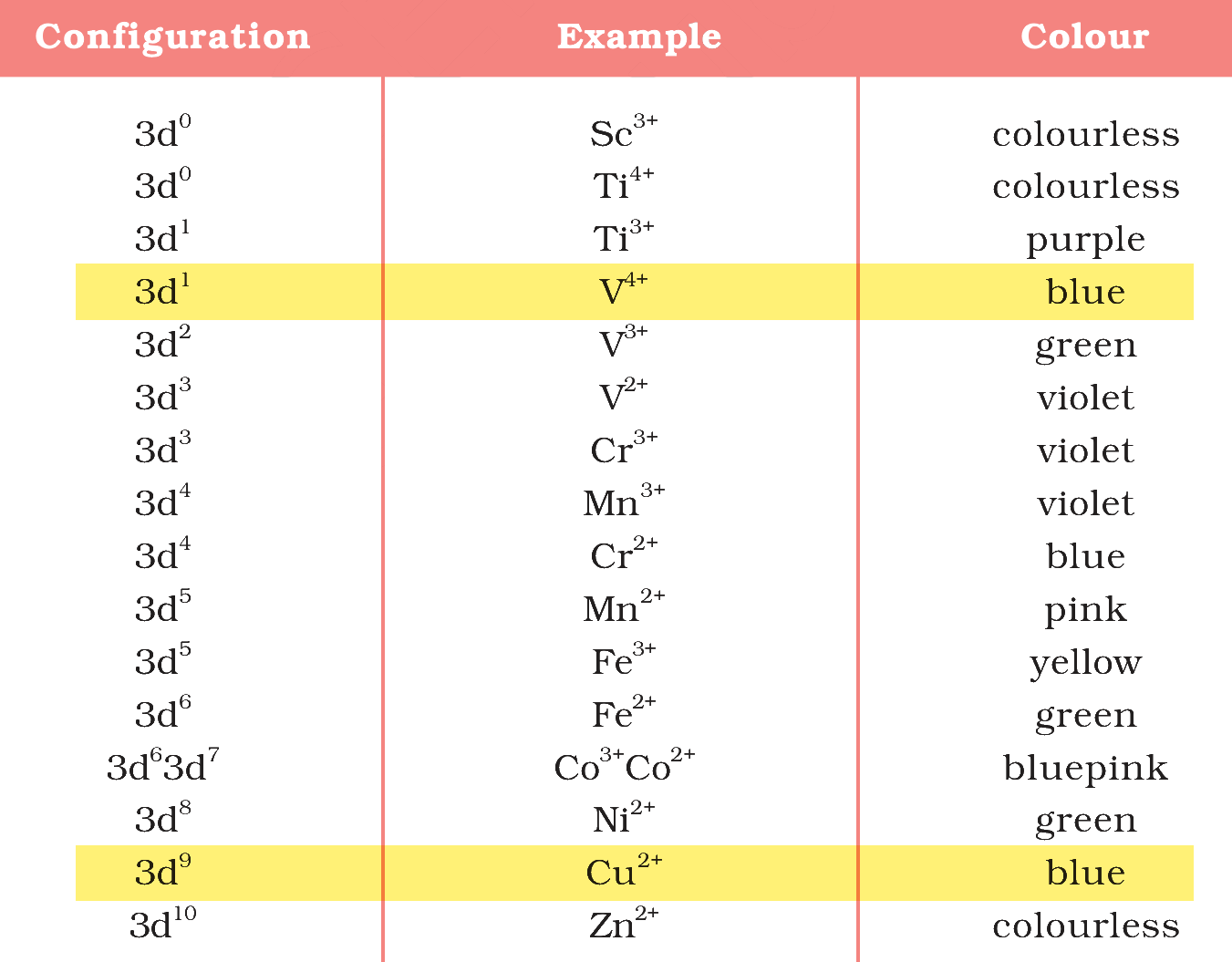
VOCl2: gives \( \ce{VO^2+} \); x + (−2) = +2, so V is +4. V (Z = 23) is [Ar]3d34s2; losing four electrons leaves 3d1: blue.
CuCl2: gives \( \ce{Cu^2+} \). Cu (Z = 29) is [Ar]3d104s1; losing two electrons leaves 3d9: blue.
Both solutions are blue.
Why the other options are incorrect
Option (2) CuCl2 and FeCl2 — Incorrect. \( \ce{Cu^2+} \) is blue but \( \ce{Fe^2+} \) (3d6) is green.
Option (3) FeCl2 and VOCl2 — Incorrect. \( \ce{Fe^2+} \) is green while the V(IV) ion is blue.
Option (4) MnCl2 and FeCl2 — Incorrect. \( \ce{Mn^2+} \) (3d5) is pink and \( \ce{Fe^2+} \) is green.
NCERT (2026-27 edition):
4.3.10 Formation of Coloured Ions – “… The frequency of the light absorbed is determined by the nature of the ligand. In aqueous solutions where water molecules are the ligands, the colours of the ions observed are listed in Table 4.8.”
Table 4.8: Colours of Some of the First Row (aquated) Transition Metal Ions