
Reaction of $C_6H_5CH_2Br$ with aqueous sodium hydroxide follows.
Answer & explanation
Correct answer: option 1
The correct answer is Option (1) → $SN^1$ mechanism
This question is based on nucleophilic substitution reactions, specifically SN¹ vs SN² mechanism.
Given compound: C₆H₅CH₂Br (benzyl bromide)
The benzyl carbocation (C₆H₅CH₂⁺) is highly stable due to resonance stabilizatioN.
The positive charge is delocalized over the benzene ring This stability strongly favors SN¹ mechanism
Mechanism reasoning:
Step 1: Formation of benzyl carbocation (rate-determining step)
Step 2: Nucleophile (OH⁻) attacks carbocation
Because the carbocation is stabilized, SN¹ is preferred even though primary alkyl halides usually favor SN².
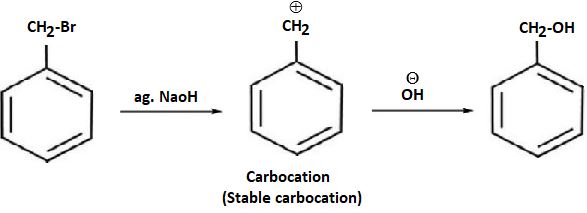
Option A: SN¹ mechanism --- Correct. Due to resonance stabilization of benzyl carbocation, reaction proceeds via SN¹.
Option B: SN² mechanism ---- Incorrect. Although benzyl halides can undergo SN², in aqueous medium with stable carbocation, SN¹ is favored.
Option C: Mechanism is dependent on temperature of the reaction-- Incorrect.-----Temperature may affect rate, but mechanism is primarily determined by carbocation stability.
Option D: Depends on concentration of aqueous sodium hydroxide--- Incorrect.--- SN¹ rate depends only on substrate concentration, not nucleophile concentration.