CUETMOCK
  • Pricing
  • Mentors
Log inStart freeStart free mocks→

First test, then trust

Try a free CUET mock test.

Join 5,00,000+ students who rehearsed exam day on the exact NTA screen before sitting CUET. On the web and on Android.

Start free mocks →Get the Android app
CUETMOCK

India's #1 CUET Mock Test Platform. Original NCERT-based questions on the exact NTA exam screen — trusted by 5,00,000+ students since CUET 2022.

Get it onGoogle PlayScan to download the CUETMOCK app

Mock tests

  • CUET mock test series
  • Browse all papers
  • Commerce mocks
  • Humanities (Arts) mocks
  • Science mocks
  • Languages & GAT mocks
  • Free practice questions
  • Pricing

Resources

  • CUET exam guide
  • CUET syllabus
  • Universities accepting CUET
  • Expert blogs
  • News & notifications
  • Webinars & counselling
  • CUET score calculator
  • How we estimate your rank
  • FAQs

Company

  • About us
  • Our leadership & team
  • Our toppers
  • Mentors
  • For schools
  • Contact us
  • Terms
  • Privacy
  • Refund policy

Talk to us

+91 7696 6630 56info@cuetmock.comWhatsApp us

Our other platforms

  • JEE Mock — For IIT-JEE aspirants
  • NEET Mock — For NEET aspirants

Newsletter

Exam updates, study material and offers — no spam.

© 2026 NYC Ventures Pvt. Ltd.

701-702, Royal Business Park, Zirakpur, Punjab - 140603

  • Terms of use
  • Privacy policy
  • Refund policy
  • Contact us

iCUETMOCK is an independent preparation platform, not affiliated with the National Testing Agency (NTA). Always check exam details on the official NTA website.

  • Home
  • Mock tests
  • CUET guide
  • Pricing
  • Log in
Home/Practice questions/Accountancy Part B
Accountancy Part BAccounting Ratios

Match List – I with List – II. List – I List – II (A) Activity Ratios…

Match List – I with List – II.

List – I

List – II

 (A) Activity Ratios 

 (I) Ratios which help in the analysis of profit
in relation to revenue from operations 

 (B) Profitability Ratios 

 (II) Ratios which determine the ability of a
business to meet its short term commitments 

 (C) Solvency Ratios 

 (III) Ratios that are calculated for measuring the efficiency
of operations of business based on effective utilisation of resources 

 (D) Liquidity Ratios 

 (IV) Ratios that determine the ability to meet its
contractual obligations towards stakeholders 

Choose the correct answer from the options given below :

Answer & explanation+

Correct answer: option 4

The correct answer is Option (4) → (A)-(III), (B)-(I), (C)-(IV), (D)-(II)

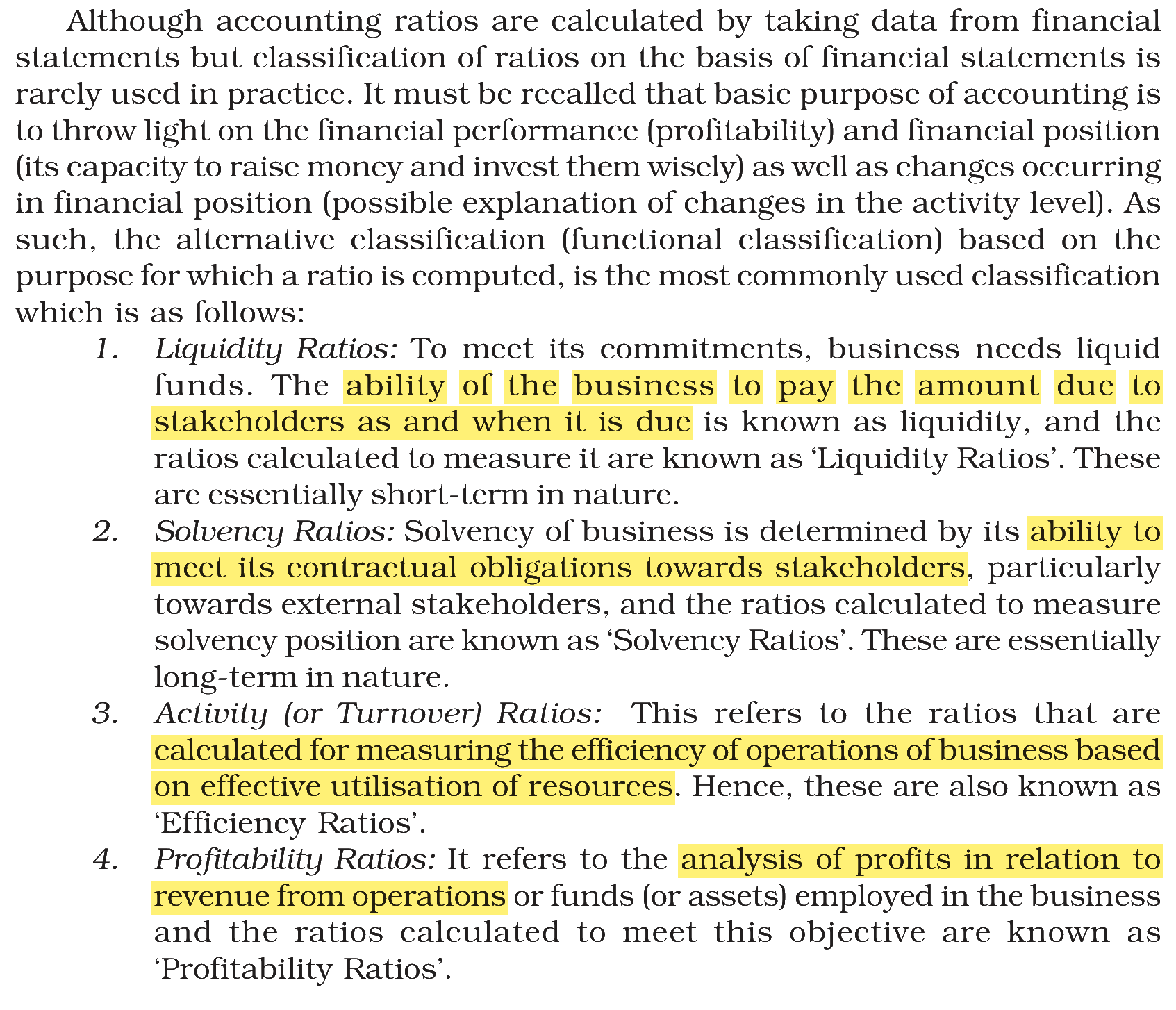
In the functional classification, ratios are grouped by the purpose for which they are worked out.

(A) Activity Ratios — this matches (III) Ratios that are calculated for measuring the efficiency of operations of business based on effective utilisation of resources. They show how fast assets are turned into sales, so they are also called efficiency ratios.

(B) Profitability Ratios — this matches (I) Ratios which help in the analysis of profit in relation to revenue from operations. Gross profit ratio and net profit ratio are examples.

(C) Solvency Ratios — this matches (IV) Ratios that determine the ability to meet its contractual obligations towards stakeholders. They are long-term in nature, such as the debt-equity ratio.

(D) Liquidity Ratios — this matches (II) Ratios which determine the ability of a business to meet its short term commitments. The current ratio and the liquid ratio belong here.

NCERT (2026-27 edition):
Types of Ratios

Extract from the NCERT textbook

Advertisement

Practise more on Accounting Ratios

Chapter-wise mocks on the real NTA exam screen, with solutions and your rank. Your first mocks are free.

Start free mocks →

Advertisement

Next questions

  1. The minimum value of the function P(x)=K_1x+(K_2)/x,\ (x gt 0,\ K_1 gt 0,\ K_2 gt 0) is :Applied Maths. Section B2 · Calculus
  2. What was the ethnicity of the person who assassinated Rajiv Gandhi?Political Science · Politics in India Since Independence: Recent Developments in Indian Politics
  3. What is the common name of 3-Bromopropene?Chemistry · Organic: Haloalkanes and Haloarenes
  4. Chemistry · Organic: Alcohols, Phenols and Ethers
  5. The difference between the compound interest and the simple interest on a sum of ₹8,000 for 2 years at the rate of 5% p.a. is:General Aptitude Test · Numerical Ability
  6. Four pairs of words are given. In three pairs the words are related in the same way. Choose the pair in which the words are related differe…General Aptitude Test · Verbal Reasoning
  7. The measure of a habitat to indefinitely sustain a population at a particular density is called:Economics · Indian Economic Development: Environment and Sustainable Development
  8. A series is given with one term missing. Select the correct alternative from the given ones that will complete the series. DMT, JOB, PQJ, V…General Aptitude Test · General Ability
  9. A line L_1 makes angles (π)/3, (π)/4, (π)/3 and a line L_2 makes angles (2π)/3, (π)/4, (π)/3 with the positive directions of the x-axis, y-…Maths. Section B1 · Three-dimensional Geometry
  10. In a ΔABC, AD, BE and CF are the medians from vertices A, B and C, respectively. The point of intersection of AD, BE and CF is called ____.General Aptitude Test · Quantitative Reasoning