Read the passage carefully and answer the following questions.
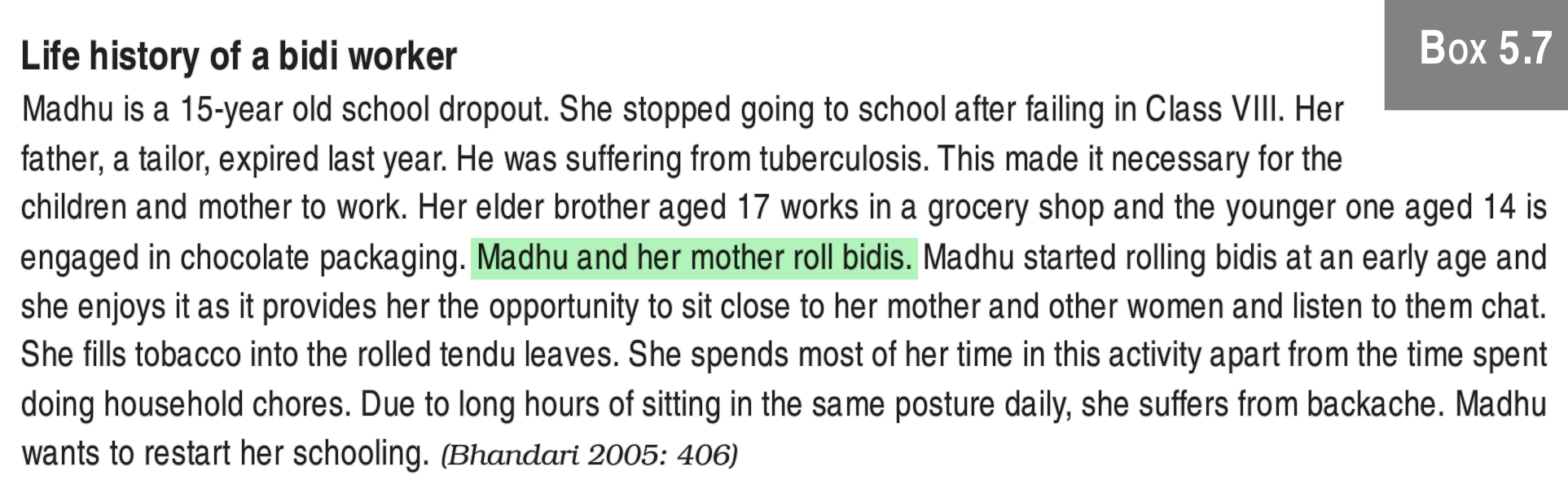
Madhu is a 15-year old school dropout. She stopped going to school after failing in class VIII. Her father, a tailor, expired last year. He was suffering from Tuberculosis. This made it necessary for the children and their mother to work. Her elder brother aged 17 years works in a grocery shop and the younger one aged 14 years is engaged in chocolate packaging. Madhu and her mother roll bidis. Madhu started rolling bidis at an early age and she enjoys it as it provides her the opportunity to sit close to her mother and other women and listen to them chat. She fills tobacco into the rolled tendu leaves. She spends most of her time in this activity apart from the time spent doing household chores. Due to long hours of sitting in the same posture daily, she suffers from backache. Madhu wants to restart her schooling.
Madhu's work can be understood as which type of work?
Answer & explanation
Correct answer: option 4
The correct answer is Option (4) → Informal work within informal sector
Option (1) Informal work within formal sector — Incorrect. The organised or formal sector consists of units employing ten or more people throughout the year, registered with the government. Madhu does not work in such a unit; she rolls bidis at home, so the sector she works in is not formal.
Option (2) Formal work within formal sector — Incorrect. Formal work in the formal sector is a regular job in a registered unit, which ensures that the employees get proper salaries or wages, pension and other benefits. Madhu has none of these.
Option (3) Formal work within informal sector — Incorrect. Her work itself is not formal: it has no fixed wage, no contract and no benefits. Home-based workers are paid only for the pieces they make.
Option (4) Informal work within informal sector — Correct. Madhu rolls bidis at home, the kind of home-based work that is paid on a piece-rate basis, with an agent bringing raw material and taking away the finished bidis. Both the work and the place where it is done lie outside the organised sector; in India, over 90% of all work is in the unorganised or informal sector.
Note 1: This passage is Box 5.7 of the pre-rationalised NCERT, which NTA followed in 2023. The box has been deleted from the NCERT book (2025-26), though the chapter’s account of the organised and unorganised sectors and of home-based work is still there.
Note 2: NCERT does not use the four phrases of the options; the answer comes from applying its formal and informal sectors and home-based work to Madhu’s work and to the place where she does it.
NCERT (2025-26): “The Specificity of Indian Industrialisation … Economists and others often make a distinction between the organised or formal and unorganised or informal sector. There is a debate over how to define these sectors. According to one definition, the organised sector consists of all units employing ten or more people throughout the year. These have to be registered with the government to ensure that their employees get proper salaries or wages, pension and other benefits. In India, over 90% of the work, whether it is in agriculture, industry or services is in the unorganised or informal sector.…” “5.6 Home-based work … Home-based work is an important part of the economy. This includes the manufacture of lace, zari or brocade, carpets, bidis, agarbattis and many such products. This work is mainly done by women and children. An agent provides raw materials and also picks up the finished product. Home workers are paid on a piece-rate basis, depending on the number of pieces they make.…”
Box 5.7, Life history of a bidi worker (Pre-rationalised NCERT) |