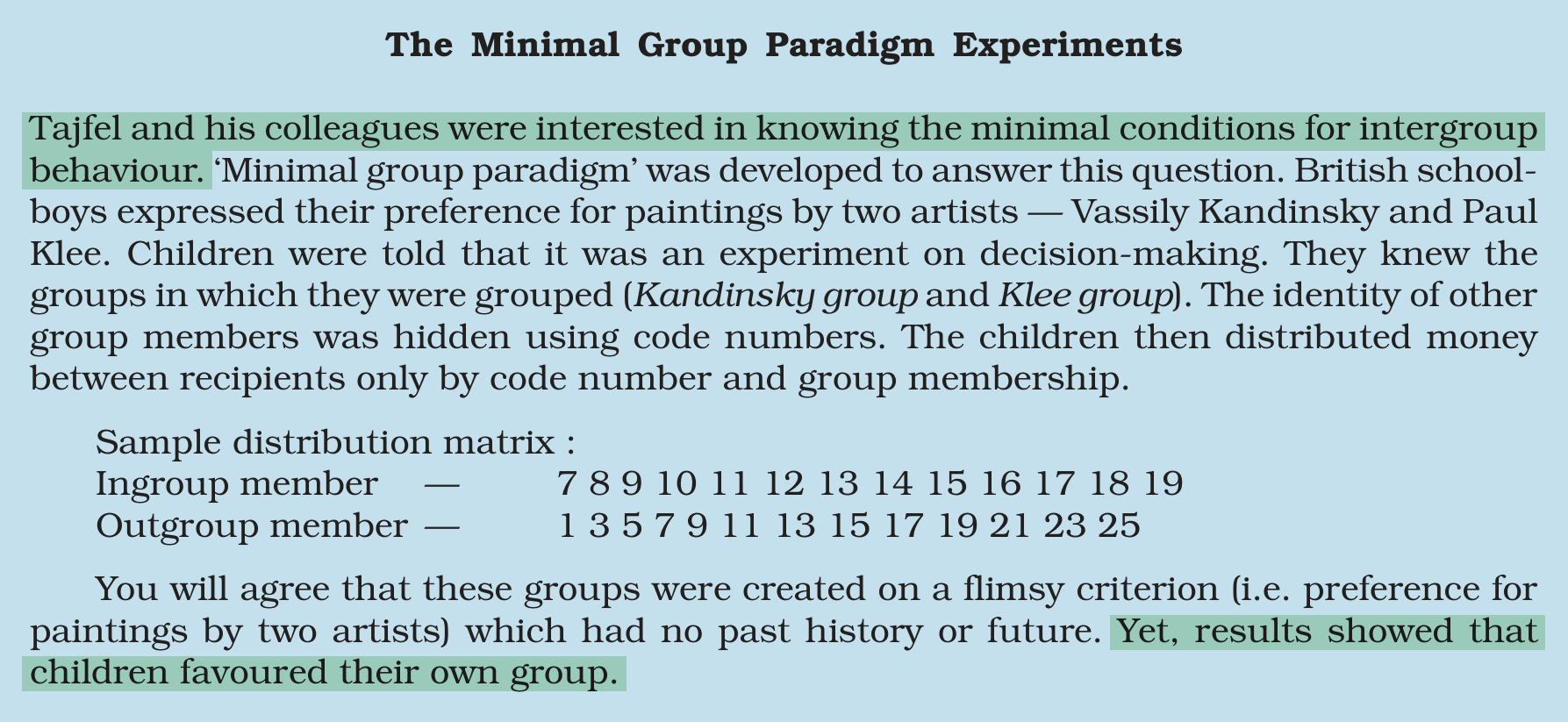
What did the results of the "minimal group paradigm" experiment conducted by Tajfel and his colleagues reveal?
Answer & explanation
Correct answer: option 2
The correct answer is Option (1) → Children favoured their own group
| Option | Reason |
|---|---|
| Option (1): Children favoured their own group. Correct. | The groups rested on a flimsy criterion with no past or future, yet the children favoured their own group when sharing money. |
| Option (2): Children had no preference for either group. Incorrect. | Having no preference would mean the money was split alike between the two groups, that is equal treatment all round. |
| Option (3): Children based their decisions on personal familiarity. Incorrect. | Personal familiarity was ruled out by the code numbers, which left each child knowing only the group of a recipient. |
| Option (4): Children allocated money randomly. Incorrect. | Random allocation would mean the money fell either way by chance. The sharing leaned towards each child's own group. |
NCERT (2026-27):
|