Which of the following will not form propionaldehyde?
Answer & explanation
Correct answer: option 3
The correct answer is option 3. 
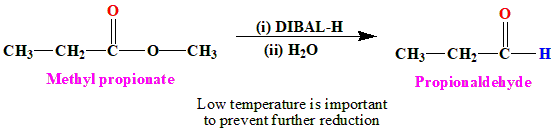
1. DIBAL (Di-isobutyl Aluminum Hydride) – A bulky reducing agent for the partial reduction of esters and nitriles. DIBAL (also known as DIBAL-H or DIBAH) is a strong, bulky reducing agent. It’s most useful for the reduction of esters to aldehydes. Unlike lithium aluminum hydride, it will not reduce the aldehyde further provided that only one equivalent is added and the reaction mixture is kept cold. It will also reduce other carbonyl compounds such as amides, aldehydes, ketones, and nitriles.
2. Ozone is a very reactive allotrope of oxygen. The reaction of ozone with alkenes and alkynes causes the oxidative cleaving of the alkene or alkyne. The carbon-carbon triple bonds are replaced with carbon-oxygen double bonds, giving the required carbonyl product as shown below.

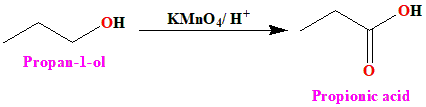
3. When propanol reacts with potassium permanganate (\(KMnO_4\)) in the presence of acid (\(H^+\)), it undergoes oxidation. Propanol (\(C_3H_7OH\)) is a primary alcohol. Upon oxidation with potassium permanganate (\(KMnO_4\)) and acid (\(H^+\)), it is converted to propanoic acid (\(C_2H_5COOH\)), which is a carboxylic acid.
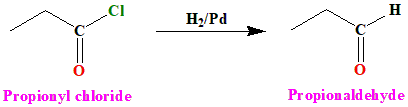
4. When propanoyl chloride (\(CH_3CH_2COCl\)) reacts with hydrogen gas (\(H_2\)) in the presence of a palladium catalyst (\(Pd\)), it undergoes reduction to form propanal (\(CH_3CH_2CHO\)).