Match List-I (classes of consumer products) with List-II (their features):
| List-I | List-II |
|---|---|
| (A) Speciality products | (I) Require guarantees and after sales services on the part of the seller. |
| (B) Non-durable products | (II) Their demand is relatively inelastic, so it does not come down even if the price is increased. |
| (C) Durable products | (III) They have low unit-value and are bought in small quantities. |
| (D) Convenience products | (IV) They generally command a small margin and should be made available in many locations. |
Choose the correct answer from the options given below:
Answer & explanation
Correct answer: option 4
The correct answer is Option (4) → (A)-(II), (B)-(IV), (C)-(I), (D)-(III)
| List-I | List-II | Reason |
|---|---|---|
| (A) Speciality products | (II) Their demand is relatively inelastic, so it does not come down even if the price is increased. | Buyers have the highest brand loyalty for these and make special efforts to buy them. So demand stays even when the price rises. |
| (B) Non-durable products | (IV) They generally command a small margin and should be made available in many locations. | These are used up in one or a few uses. They earn a small margin and must be sold in many places. |
| (C) Durable products | (I) Require guarantees and after sales services on the part of the seller. | These last many years, so buyers expect guarantees and after sales services. |
| (D) Convenience products | (III) They have low unit-value and are bought in small quantities. | These are bought often, at once and with little effort; they have low unit-value. |
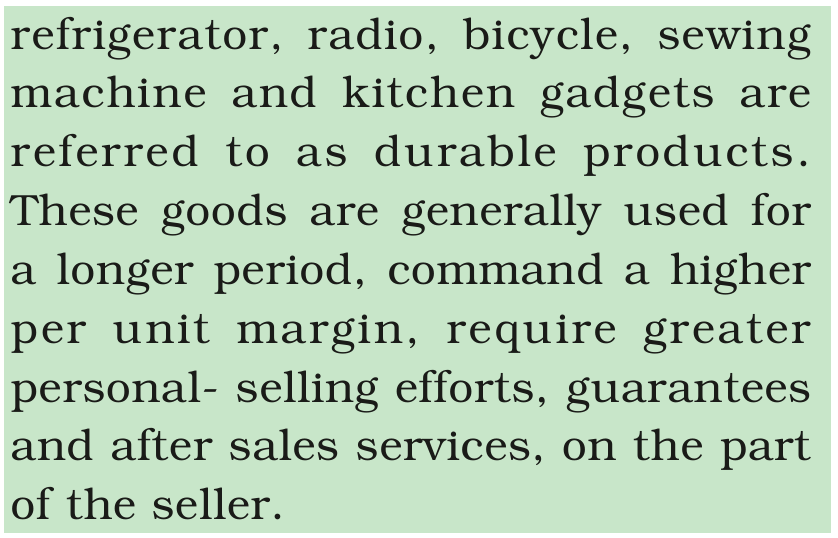
NCERT (2026-27 Edition): “1. Convenience Products: Those consumer products, which are purchased frequently, immediately and with least time and efforts are referred to as convenience goods. Examples of such products are cigarettes, ice creams, medicines, newspaper, stationery items toothpaste etc. These products have low unit-value and are bought in small qualities.” “3. Speciality Products: … The demand for these goods is relatively inelastic, i.e., even if the price is increased, the demand does not come down.” “1. Non-durable Products: The consumer products which are normally consumed in one or few uses are called non-durable products. For example, products like toothpaste, detergents, bathing soap and stationary products etc. From the marketing point of view, these products generally command a small margin, should be made available in many locations and need to be heavily advertised.” “2. Durable Products: Those tangible consumer products which normally survive many years, for example, …”
|