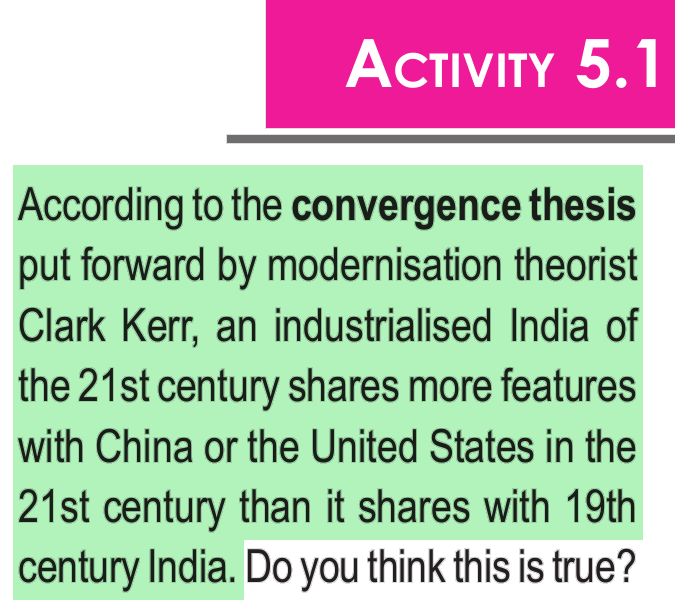
An industrialised India of the 21st century shares more features with China or the U.S.A. in the 21st century than it shares with 19th century India. Identify the theory which suggests this?
Answer & explanation
Correct answer: option 2
The correct answer is Option (2) → convergence thesis of Modern Theory
Option (1) convergence thesis of Post-Modern Theory — Incorrect. Post-modern theory doubts any single path of progress that all societies must follow and stresses difference and variety. A thesis that all industrial societies grow alike is the opposite of its view.
Option (2) convergence thesis of Modern Theory — Correct. The convergence thesis was put forward by the modernisation theorist Clark Kerr. It holds that industrialisation makes societies more and more alike, so that an industrialised India of the 21st century shares more features with China or the United States than with 19th century India.
Option (3) convergence thesis of Conflict Theory — Incorrect. Conflict theory, from Karl Marx, explains society through the struggle between classes with opposed interests, such as owners and workers. It does not argue that industrial countries come to resemble each other.
Option (4) convergence thesis of Symbolic Interaction Theory — Incorrect. Symbolic interactionism studies how people create meanings through everyday face-to-face interaction, using symbols such as language and gestures. It looks at small-scale social life, not at whole industrial societies growing alike.
Note: The theories in Option (1), ‘Post-Modern Theory’, Option (3), ‘Conflict Theory’, and Option (4), ‘Symbolic Interaction Theory’, are not in NCERT (2025-26); explained here for the benefit of the students.
NCERT: Social Change and Development in India — Chapter 5: Change and Development in Industrial Society, Activity 5.1 (2025-26)
|