
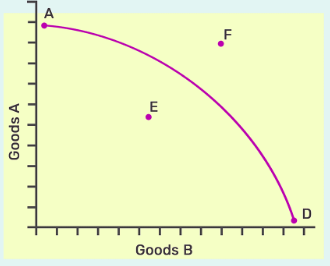
Consider an economy with fixed amount of resources and given technological state. It produces only 2 goods – Good A and Good B. Different combinations showing maximum outputs of two goods which can be produced (when given resources and technology are used fully) are plotted on a graph. When all the plotted points are joined, following graph was obtained.
Based on the above graph, answer the following questions.
There was lack of skills among people because of which people were unemployed. Government introduced Kaushal Vikas Yojana for skilling the existing youth. As a result the entire workforce got skilled and got a job. What will this lead to?
Answer & explanation
Correct answer: option 1
The correct answer is Option 1: Movement from E to a point on curve
In the given graph, point E lies inside the Production Possibility Curve (PPC), which represents underutilization of resources — in this case, due to a lack of skills among the workforce. When the government introduces a programme like Kaushal Vikas Yojana, it helps equip people with the necessary skills, thereby reducing unemployment and improving the efficiency of resource use. As a result, the economy moves from a point inside the PPC (like E) to a point on the curve, where all available resources are being fully and efficiently utilized. This does not expand the economy's capacity but ensures optimal use of existing resources.
Why not other options?
-
Option 2 (E to F): F lies outside the PPC — this is not possible unless resources or technology improve.
-
Option 3 (Shift of PPC leftwards): Would mean a decline in resources or technology — not the case here.
-
Option 4 (No change): There is a change — better utilization of resources.
Skill development programme can lead to a rightward shift of the Production Possibility Curve (PPC) if it results in a permanent increase in the productive capacity of the economy. Such a shift occurs due to factors like technological advancement, an increase in resource availability, or a significant improvement in the quality of human capital that enables the economy to produce more output with the same inputs.
However, it's important to distinguish between a permanent capacity increase and the better utilization of existing resources. If skilling simply leads to the full and efficient use of the existing workforce—as described in the question—then the economy is moving from a point inside the PPC (like point E) to a point on the same curve, not to a new PPC. This is because the total quantity and quality of resources have remained the same; there is no mention of enhanced productivity or expanded resource base.
In the given scenario, the presence of unemployment due to lack of skills clearly implies underutilization of existing resources, placing the economy initially inside the PPC. The government’s skill development programme then enables full employment, allowing the economy to operate on the PPC, where all resources are used efficiently.
A rightward shift of the PPC would only be appropriate if the skilling programme had permanently increased output capacity, which is not indicated in this case. Therefore, the correct interpretation is a movement from point E to a point on the existing PPC, not a shift of the curve itself.
However, if point E were already on the PPC, it would imply that the economy was operating at full efficiency. In that case, if a skill development programme still led to higher output, it would mean that the programme had enhanced the productive capacity of the labour force, thus resulting in a rightward shift of the PPC, indicating economic growth.