
CUETMOCK
  • Pricing
  • Mentors
Log inStart freeStart free mocks→

First test, then trust

Try a free CUET mock test.

Join 5,00,000+ students who rehearsed exam day on the exact NTA screen before sitting CUET. On the web and on Android.

Start free mocks →Get the Android app
CUETMOCK

India's #1 CUET Mock Test Platform. Original NCERT-based questions on the exact NTA exam screen — trusted by 5,00,000+ students since CUET 2022.

Get it onGoogle PlayScan to download the CUETMOCK app

Mock tests

  • CUET mock test series
  • Commerce mocks
  • Humanities (Arts) mocks
  • Science mocks
  • Languages & GAT mocks
  • Free practice questions
  • Pricing

Resources

  • CUET exam guide
  • CUET syllabus
  • Universities accepting CUET
  • Expert blogs
  • News & notifications
  • Webinars & counselling
  • CUET score calculator
  • How we estimate your rank
  • FAQs

Company

  • About us
  • Our leadership & team
  • Our toppers
  • Mentors
  • For schools
  • Contact us
  • Terms
  • Privacy
  • Refund policy

Talk to us

+91 7696 6630 56info@cuetmock.comWhatsApp us

Our other platforms

  • JEE Mock — For IIT-JEE aspirants
  • NEET Mock — For NEET aspirants

Newsletter

Exam updates, study material and offers — no spam.

© 2026 NYC Ventures Pvt. Ltd.

701-702, Royal Business Park, Zirakpur, Punjab - 140603

  • Terms of use
  • Privacy policy
  • Refund policy
  • Contact us

iCUETMOCK is an independent preparation platform, not affiliated with the National Testing Agency (NTA). Always check exam details on the official NTA website.

  • Home
  • Mock tests
  • CUET guide
  • Pricing
  • Log in
Home/Practice questions/Chemistry
ChemistryPhysical: Surface Chemistry

Identify correct increasing order of coagulation power of electrolyte…

A colloid is a heterogeneous system in which one substance is dispersed as very fine particles in another substance called dispersion medium. Colloids are classified on the basis of physical state of dispersed phase and dispersion medium, nature of interaction between dispersed phase and dispersion medium and types of particles of dispersed phase. There are various methods for the preparation of colloidal solutions such as chemical methods, electrical disintegration and peptization. Colloidal solutions when prepared, generally contain excessive amount of electrolytes, and some other soluble impurities. The process used for reducing the amount of impurities to a requisite minimum is known as purification of colloidal solution. Purification of colloidal solution is carried out by various methods such as Dialysis, Electrodialysis, Ultrafiltration etc. Colligative properties, Tyndall effect, colour, Brownian movement, charge on colloidal particles, electrophoresis, coagulation are various properties exhibited by colloidal solution.

Identify correct increasing order of coagulation power of electrolytes:

A. NaCl < MgCl2 < AlCl3
B. AlCl3 < MgCl2 < NaCl
C. Na4[Fe(CN)6] < Na3PO4 < NaCl < Na2SO4
D. KCl < K3PO4 < K2SO4 < K4[Fe(CN)6]
E. KCl < K2SO4 < K3PO4 < K4[Fe(CN)6]

Choose the correct answer from the options given below:

Answer & explanation+

Correct answer: option 4

The correct answer is Option (4) → A, E only

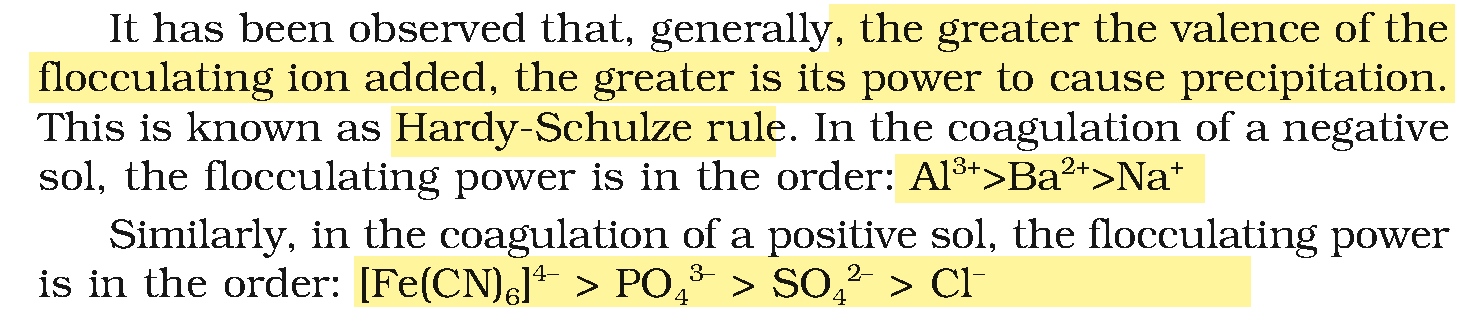
By the Hardy-Schulze rule, the coagulating power of an ion increases with its charge (valence). The ion that coagulates a sol has the charge opposite to that of the sol: cations coagulate a negative sol, anions a positive sol.

  • (A) NaCl < \( \ce{MgCl2} \) < \( \ce{AlCl3} \) — Correct. For a negative sol the active ions are \( \ce{Na^{+}} \) < \( \ce{Mg^{2+}} \) < \( \ce{Al^{3+}} \) (charge 1, 2, 3).

  • (B) \( \ce{AlCl3} \) < \( \ce{MgCl2} \) < NaCl — Incorrect. This is the reverse order.

  • (C) \( \ce{Na4[Fe(CN)6]} \) < \( \ce{Na3PO4} \) < NaCl < \( \ce{Na2SO4} \) — Incorrect. The anion charges −4, −3, −1, −2 are not in increasing order.

  • (D) KCl < \( \ce{K3PO4} \) < \( \ce{K2SO4} \) < \( \ce{K4[Fe(CN)6]} \) — Incorrect. \( \ce{PO4^{3-}} \) (−3) is placed below \( \ce{SO4^{2-}} \) (−2).

  • (E) KCl < \( \ce{K2SO4} \) < \( \ce{K3PO4} \) < \( \ce{K4[Fe(CN)6]} \) — Correct. For a positive sol: \( \ce{Cl^{-}} \) < \( \ce{SO4^{2-}} \) < \( \ce{PO4^{3-}} \) < \( \ce{[Fe(CN)6]^{4-}} \).

Note: This question is from the pre-rationalised NCERT book (2022-23). The topic is not there in the latest NCERT book (2026-27), and it is also out of the CUET 2026 syllabus.

NCERT (Pre-rationalised edition, 2022-23):
Coagulation or Precipitation – …
Textbook extract

Advertisement

Practise more on Physical: Surface Chemistry

Chapter-wise mocks on the real NTA exam screen, with solutions and your rank. Your first mocks are free.

Start free mocks →

Advertisement

Next questions

  1. What is the new potential difference due to insertion of the dielectric?Physics · Electrostatic Potential and Capacitance
  2. Read the given statement and conclusions carefully and decide which of the conclusions logically follow(s) from the statement. Statement: A…General Aptitude Test · Verbal Reasoning
  3. Select the correct statement (s) from below.Sociology · Social Change and Development in India: Cultural Change
  4. StrengthenEnglish · Antonyms
  5. Why does aluminum not degrade in nature quickly?Chemistry · Inorganic: P Block Elements
  6. ∫√((1-cos 2x)/(1+cos 2x))dx=Maths. Section A · Indefinite Integration
  7. What will be the value of (cot 24°)/(tan 66°) ?General Aptitude Test · Quantitative Reasoning
  8. Match List – I with List – II. LIST I LIST II A. Stock of goods in hand at the beginning of the accounting year I. Direct expense B. Freigh…Accountancy · Financial Statements - I
  9. What is the amount of hidden goodwill in Z's share?Accountancy Part A · Reconstitution of Partnership Firm: Retirement and Death
  10. Identify the correct order of steps involved in Bidi-making industry: (A) The government then auctions the leaves to bidi factory owners (B…Sociology · Social Change and Development in India: Change and Development in industrial Society