In macroeconomics, when a price is constant, equilibrium is achieved at a point where?
Answer & explanation
Correct answer: option 3
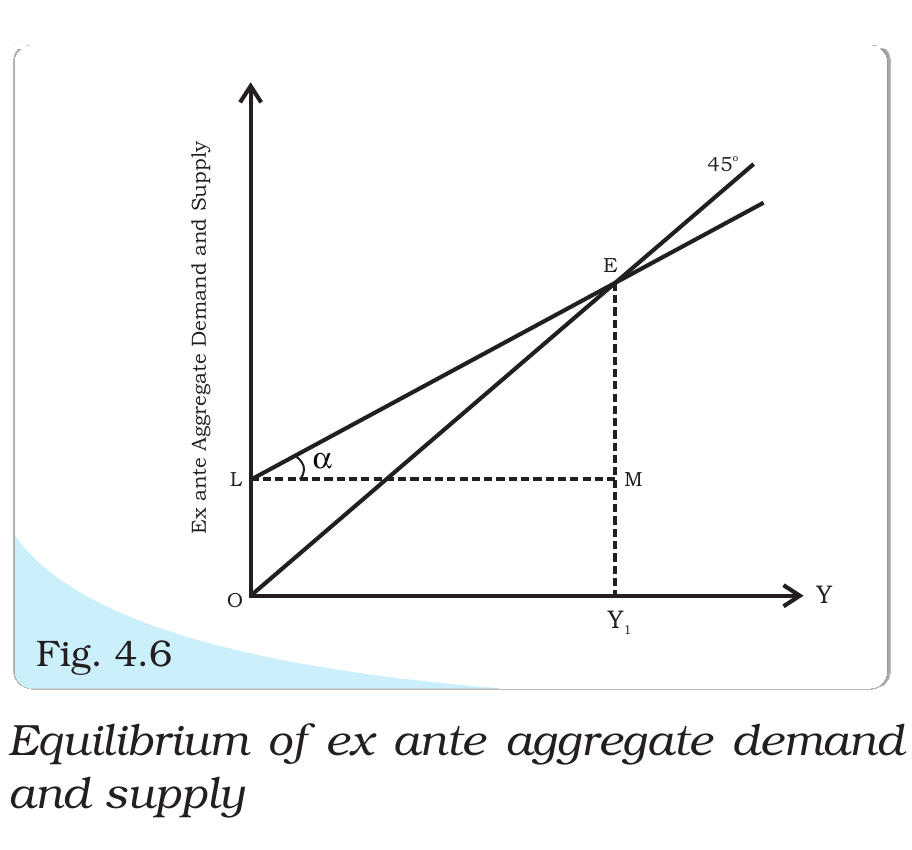
The correct answer is Option (3) → Ex ante Aggregate Demand = Ex ante Aggregate Supply.
Ex ante means what is planned. With the price level fixed, the economy is in equilibrium where planned aggregate demand equals planned aggregate supply.
Option (1) Demand = Supply. — Incorrect. This is the equilibrium of a single market in microeconomics, where demand and supply also decide the price. Here the price is fixed and the whole economy is studied.
Option (2) ex-post Aggregate Demand = Aggregate Supply. — Incorrect. Ex post means actual values. Actual output always equals actual consumption plus actual investment, in equilibrium or out of it. So this equality cannot mark equilibrium.
Option (3) Ex ante Aggregate Demand = Ex ante Aggregate Supply. — Correct. When planned demand equals planned output, firms have no reason to change their output.
Option (4) Consumption = Investment. — Incorrect. These are two parts of aggregate demand. Equilibrium compares their sum with aggregate supply.
NCERT (2026-27): “4.1 Aggregate Demand and Its Components In the chapter on National Income Accounting, we have come across terms like consumption, investment, or the total output of final goods and services in an economy (GDP). These terms have dual connotations. In Chapter 2 they were used in the accounting sense – denoting actual values of these items as measured by the activities within the economy in a certain year. We call these actual or accounting values ex post measures of these items.… 4.3.1 Macroeconomic Equilibrium with Price Level Fixed … You would recall that in microeconomic theory when we analyse the equilibrium of demand and supply in a single market, the demand and supply curves simultaneously determine the equilibrium price and the equilibrium quantity. In macroeconomic theory we proceed in two steps: at the first stage, we work out a macroeconomic equilibrium taking the price level as fixed. At the second stage, we allow the price level to vary and again, analyse macroeconomic equilibrium.… Equilibrium … Equilibrium is shown graphically by putting ex ante aggregate demand and supply together in a diagram (Fig. 4.6). The point where ex ante aggregate demand is equal to ex ante aggregate supply will be equilibrium.…”
|