
CUETMOCK
  • Pricing
  • Mentors
Log inStart freeStart free mocks→

First test, then trust

Try a free CUET mock test.

Join 5,00,000+ students who rehearsed exam day on the exact NTA screen before sitting CUET. On the web and on Android.

Start free mocks →Get the Android app
CUETMOCK

India's #1 CUET Mock Test Platform. Original NCERT-based questions on the exact NTA exam screen — trusted by 5,00,000+ students since CUET 2022.

Get it onGoogle PlayScan to download the CUETMOCK app

Mock tests

  • CUET mock test series
  • Browse all papers
  • Commerce mocks
  • Humanities (Arts) mocks
  • Science mocks
  • Languages & GAT mocks
  • Free practice questions
  • Pricing

Resources

  • CUET exam guide
  • CUET syllabus
  • Universities accepting CUET
  • Expert blogs
  • News & notifications
  • Webinars & counselling
  • CUET score calculator
  • How we estimate your rank
  • FAQs

Company

  • About us
  • Our leadership & team
  • Our toppers
  • Mentors
  • For schools
  • Contact us
  • Terms
  • Privacy
  • Refund policy

Talk to us

+91 7696 6630 56info@cuetmock.comWhatsApp us

Our other platforms

  • JEE Mock — For IIT-JEE aspirants
  • NEET Mock — For NEET aspirants

Newsletter

Exam updates, study material and offers — no spam.

© 2026 NYC Ventures Pvt. Ltd.

701-702, Royal Business Park, Zirakpur, Punjab - 140603

  • Terms of use
  • Privacy policy
  • Refund policy
  • Contact us

iCUETMOCK is an independent preparation platform, not affiliated with the National Testing Agency (NTA). Always check exam details on the official NTA website.

  • Home
  • Mock tests
  • CUET guide
  • Pricing
  • Log in
Home/Practice questions/Physics
PhysicsRay Optics

A convex lens of focal length 30 cm forms an image of height 2 cm of…

A convex lens of focal length 30 cm forms an image of height 2 cm of an object placed at infinity. Now a concave lens of focal length 20 cm is placed at a distance of 26 cm to the side in which image is formed. The height of image formed by the combined system of the same object is

Answer & explanation+

Correct answer: option 1

For concave lens,

f = -20 cm

u = +4 cm
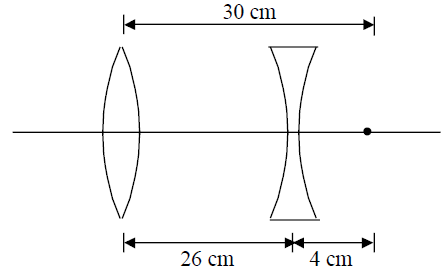
$m=\frac{F}{u+F}=\frac{-20}{+4-20}=\frac{-20}{-16}=\frac{5}{4} $

$\frac{I}{O}=\frac{v}{4}=\frac{5}{4}$

I = +2.5 cm

∴ (a)

Advertisement

Practise more on Ray Optics

Chapter-wise mocks on the real NTA exam screen, with solutions and your rank. Your first mocks are free.

Start free mocks →

Advertisement

Next questions

  1. A policy which involves fixing the maximum size of land which could be owned by an individual is called ______.General Aptitude Test · General Knowledge
  2. Physics · Ray Optics
  3. Variation of particle momentum and the associated de-Broglie wavelength is represented byPhysics · Dual Nature of Radiation and Matter
  4. If the vector i-3 j+5 k bisects the angle between a and -i+2 j+2 k, where a is a unit vector, then:Maths. Section B1 · Vectors
  5. Identify the most acidic alcohol among the following:Chemistry · Organic: Alcohols, Phenols and Ethers
  6. Three different positions of the same dice are shown. Select the number that will be on the face opposite to the face showing '6'.General Aptitude Test · Verbal Reasoning
  7. Who is the author of the text 'The sources of knowledge' ?Sociology · Social Change and Development in India: Cultural Change
  8. Raman and Sanjay started a business by investing ₹63000 and ₹42000 respectively. If the total profit at the end of year is ₹9000, then what…General Aptitude Test · Numerical Ability
  9. Borra caves are situated on the East Coast of India in which of the following hills?General Aptitude Test · General Knowledge
  10. The level of output is determined by the .....Economics · Macro Economics: Determination of Income and Employment