
Variation of particle momentum and the associated de-Broglie wavelength is represented by
Answer & explanation
Correct answer: option 3
The correct answer is Option (3)
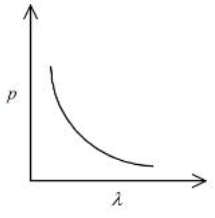
The de Broglie relation connects the wavelength with the momentum, \( \lambda = \frac{h}{p} \), so \( p = \frac{h}{\lambda} \). The momentum is inversely proportional to the wavelength, and the graph of p against \( \lambda \) is a rectangular hyperbola.
As \( \lambda \) becomes small, p becomes very large, and as \( \lambda \) becomes large, p falls towards zero without ever touching either axis. Option (3) shows exactly this falling curve.
Why the other options are incorrect
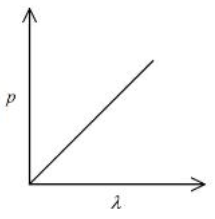
Option (1) — Incorrect. A straight line through the origin means \( p\propto\lambda \), so p would grow with the wavelength, the opposite of the de Broglie relation.
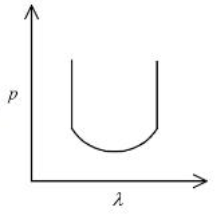
Option (2) — Incorrect. The momentum would first fall and then rise again with \( \lambda \), but \( p = h/\lambda \) falls steadily.
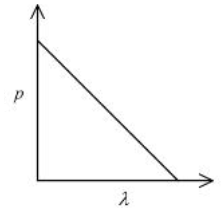
Option (4) — Incorrect. A straight line of negative slope means p falls linearly and becomes zero at a finite wavelength, whereas \( p = h/\lambda \) is a hyperbola that never reaches zero.
NCERT (2026-27):
Wave Nature of Matter – “… De Broglie proposed that the wave length \( \lambda \) associated with a particle of momentum \( p \) is given as
\( \displaystyle \lambda = \frac{h}{p} = \frac{h}{mv} \qquad (11.5) \)
where m is the mass of the particle and v its speed. Equation (11.5) is known as the de Broglie relation.”