
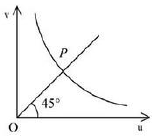
The graph in the given figure shows plot of variations of \( v \) with change in \( u \) for a concave mirror. Points plotted above the point P on the curve are for value of \( v \):
Answer & explanation
Correct answer: option 2
The correct answer is Option (2) → Larger than 2f
For a concave mirror the mirror formula is \( \frac{1}{v} + \frac{1}{u} = \frac{1}{f} \), where u and v are the magnitudes of the object and image distances for a real image. The 45° line is \( v = u \), so P, where it cuts the curve, is the point with equal distances.
\( \displaystyle \frac{1}{u} + \frac{1}{u} = \frac{1}{f} \Rightarrow u = v = 2f \)
P is therefore the point where the object is at the centre of curvature. On the curve, \( v = \frac{uf}{u - f} \) falls as u increases, so the points above P have a larger v than at P:
\( v \gt 2f \)
The corresponding object distances lie between f and 2f.
Why the other options are incorrect
Option (1) Smaller than 2f — Incorrect. These are the points below P, where the object is beyond 2f.
Option (3) Smaller than f — Incorrect. A real image cannot be formed closer than f, so no point of the curve has such a v.
Option (4) Larger than f but less than 2f — Incorrect. This is the range of the object distance u for the points above P, not of the image distance v.