CUETMOCK
  • Pricing
  • Mentors
Log inStart freeStart free mocks→

First test, then trust

Try a free CUET mock test.

Join 5,00,000+ students who rehearsed exam day on the exact NTA screen before sitting CUET. On the web and on Android.

Start free mocks →Get the Android app
CUETMOCK

India's #1 CUET Mock Test Platform. Original NCERT-based questions on the exact NTA exam screen — trusted by 5,00,000+ students since CUET 2022.

Get it onGoogle PlayScan to download the CUETMOCK app

Mock tests

  • CUET mock test series
  • Browse all papers
  • Commerce mocks
  • Humanities (Arts) mocks
  • Science mocks
  • Languages & GAT mocks
  • Free practice questions
  • Pricing

Resources

  • CUET exam guide
  • CUET syllabus
  • Universities accepting CUET
  • Expert blogs
  • News & notifications
  • Webinars & counselling
  • CUET score calculator
  • How we estimate your rank
  • FAQs

Company

  • About us
  • Our leadership & team
  • Our toppers
  • Mentors
  • For schools
  • Contact us
  • Terms
  • Privacy
  • Refund policy

Talk to us

+91 7696 6630 56info@cuetmock.comWhatsApp us

Our other platforms

  • JEE Mock — For IIT-JEE aspirants
  • NEET Mock — For NEET aspirants

Newsletter

Exam updates, study material and offers — no spam.

© 2026 NYC Ventures Pvt. Ltd.

701-702, Royal Business Park, Zirakpur, Punjab - 140603

  • Terms of use
  • Privacy policy
  • Refund policy
  • Contact us

iCUETMOCK is an independent preparation platform, not affiliated with the National Testing Agency (NTA). Always check exam details on the official NTA website.

  • Home
  • Mock tests
  • CUET guide
  • Pricing
  • Log in
Home/Practice questions/General Aptitude Test
General Aptitude TestVerbal ReasoningSyllogism

Three Statements are given followed by Three conclusions numbered I,…

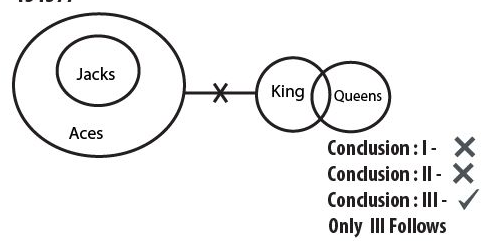
Three Statements are given followed by Three conclusions numbered I, II and III. Assuming the statements to be true, even if they seem to be at variance with commonly known facts, decide which of the conclusions logically follow(s) from the statements.

Statements:

All jacks are aces.

No ace is a king.

Some queens are kings.

Conclusions:

I. Some queens are jacks.

II. Some kings are jacks.

III. No jack is a king.

Answer & explanation+

Correct answer: option 2

Advertisement

Practise more on Verbal Reasoning

Chapter-wise mocks on the real NTA exam screen, with solutions and your rank. Your first mocks are free.

Start free mocks →

Advertisement

Next questions

  1. Which among the following pair of words carry the same relationship as: Cheerful : MerryEnglish · Analogy
  2. Which of the following enzyme is used during isolation of DNA from fungal cells?Biology · Biotechnology -Principles and Processes
  3. Savage Ltd. Purchased for cancellation its own 12,00,000, 9% debentures of ₹100 each at ₹85 each. The profit on cancellation of own debentu…Accountancy Part A · Issue and Redemption of Debentures
  4. The length of the body diagonal of a cube is 8√3 cm. What is the volume (in cm3) of the cube?General Aptitude Test · Quantitative Reasoning
  5. Which of the following are incorrect statements regarding Gross Domestic Product (GDP)?(A) GDP is a measure of the welfare of a country.(B)…Economics · Macro Economics: National Income Accounting
  6. Who among the following Indian Playback Singers holds the Guinness world record for singing the highest number of songs in one day?General Aptitude Test · General Knowledge
  7. Degree of the differential equation (d^2y)/(dx^2)+3≤ft(dy/dx)^1/2=y^2+e^x is:Maths. Section A · Differential Equations (Section A)
  8. Select the figure from among the given options that can replace the question mark (?) in the following series.General Aptitude Test · Verbal Reasoning
  9. Three of the following letter-clusters are alike in some manner and hence form a group. Which letter-cluster does not belong to that group?General Aptitude Test · General Ability
  10. Mahatma Gandhi attended the Second Round Table Conference in London in 1931. Identify the demand he opposed and the reason he gave for oppo…History · Modern India: Mahatma Gandhi and the Nationalist movement