
The major products A and B formed in the following reaction are :
\( \displaystyle \mathbf{B} \xleftarrow{\ce{AgCN}} \ce{H3C-CH2-Br} \xrightarrow{\ce{KCN}} \mathbf{A} \)
Answer & explanation
Correct answer: option 1
The correct answer is Option (1) → A = CH3CH2CN
B = CH3CH2NC
The cyanide group is an ambident nucleophile: it has two nucleophilic centres, carbon and nitrogen, so it can attack an alkyl halide through either atom. Which atom attacks depends on the cyanide used:
KCN is ionic and gives free \( \ce{CN^-} \) ions in solution. Both C and N could donate a lone pair, but the attack takes place mainly through carbon, because a C–C bond is more stable than a C–N bond. The product is an alkyl cyanide (nitrile):
\( \displaystyle \ce{CH3CH2Br + KCN -> CH3CH2-C#N + KBr} \)
AgCN is mainly covalent (Ag–C≡N). Carbon is already bonded to silver, so only the lone pair on nitrogen is free to attack. The product is an isocyanide:
\( \displaystyle \ce{CH3CH2Br + AgCN -> CH3CH2-N#C + AgBr} \)
So A (with KCN) is propanenitrile, \( \ce{CH3CH2CN} \), and B (with AgCN) is ethyl isocyanide, \( \ce{CH3CH2NC} \).
Why the other options are incorrect
Option (2) A = CH3CH2CN, B = CH3CH2CN — Incorrect. A is right, but AgCN cannot attack through carbon, which is held by silver, so it does not give the nitrile.
Option (3) A = CH3CH2NC, B = CH3CH2NC — Incorrect. B is right, but the free \( \ce{CN^-} \) ion from KCN attacks through carbon, so KCN gives the nitrile, not the isocyanide.
Option (4) A = CH3CH2NC, B = CH3CH2CN — Incorrect. This gives the two products the wrong way round: ionic KCN gives the cyanide and covalent AgCN gives the isocyanide.
NCERT (2026-27 edition):
Reactions of Haloalkanes
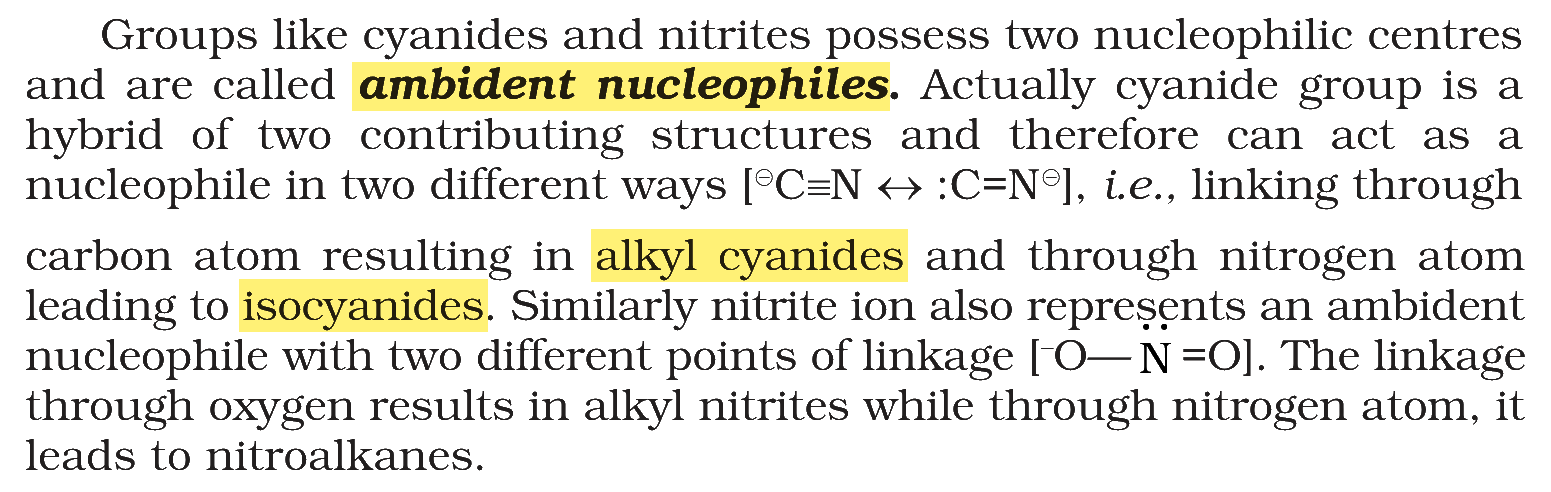
Reactions of Haloalkanes – “… KCN is predominantly ionic and provides cyanide ions in solution. Although both carbon and nitrogen atoms are in a position to donate electron pairs, the attack takes place mainly through carbon atom and not through nitrogen atom since C—C bond is more stable than C—N bond. However, AgCN is mainly covalent in nature and nitrogen is free to donate electron pair forming isocyanide as the main product.”