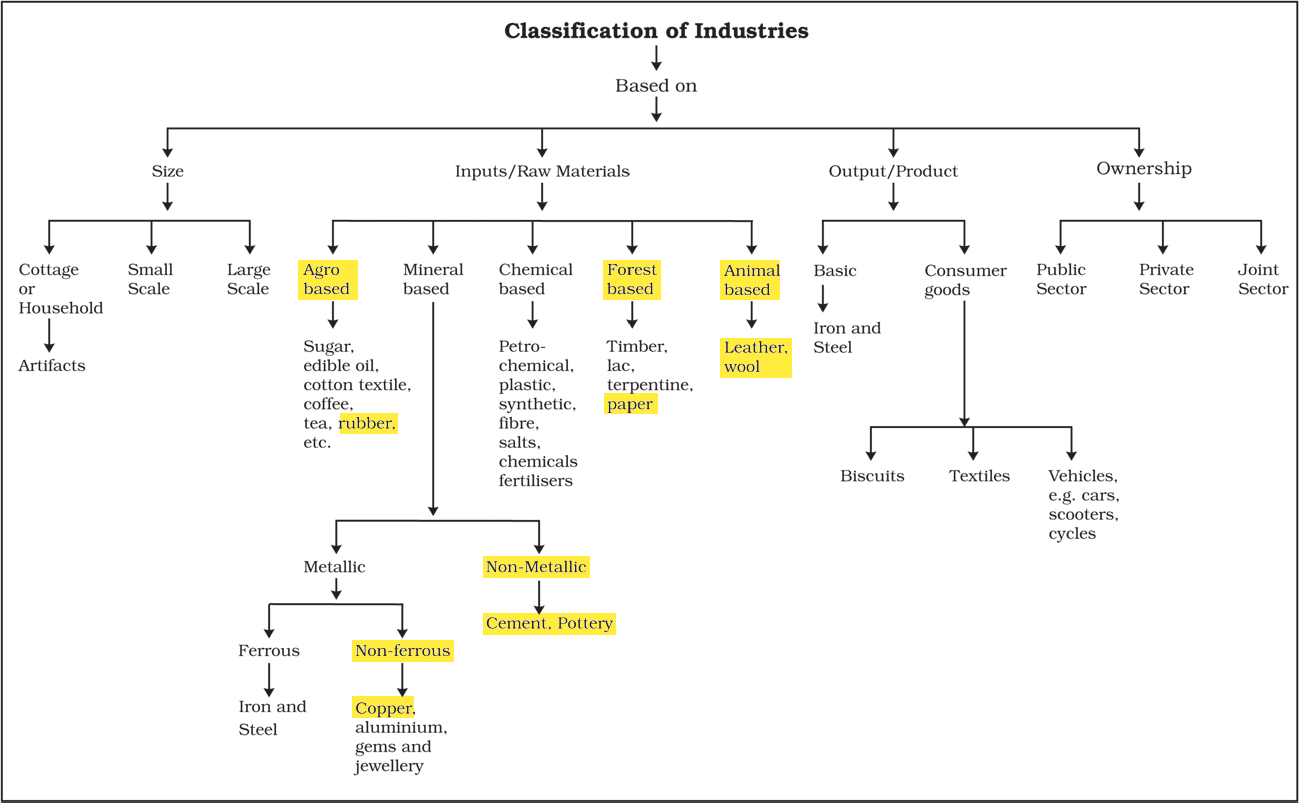
Identify the correct combinations of raw material as input and industry.
(A) Agro based - Rubber
(B) Animal based - Pottery
(C) Forest based - Paper
(D) Non-ferrous mineral based - Copper
Choose the correct answer from the options given below:
Answer & explanation
Correct answer: option 3
The correct answer is Option (3) → (A), (C) and (D) only.
A pair is correct when the industry really draws its raw material from that source.
(A) Agro based - Rubber — Correct. Rubber comes from rubber trees grown on farms and plantations.
(B) Animal based - Pottery — Incorrect. Pottery is made from clay, a non-metallic mineral, so it is mineral based.
(C) Forest based - Paper — Correct. Paper is made from wood, bamboo and grass, and these come from forests.
(D) Non-ferrous mineral based - Copper — Correct. Non-ferrous minerals have no iron in them, and copper is one of them.
NCERT (2026-27): “Industries based on Inputs/Raw Materials … On the basis of the raw materials used, the industries are classified as: (a) agro-based; (b) mineral based; (c) chemical based; (d) forest based: and (e) animal based.… Major agro-processing industries are food processing, sugar, pickles, fruits juices, beverages (tea, coffee and cocoa), spices and oils fats and textiles (cotton, jute, silk), rubber, etc.” “(b) Mineral based Industries … These industries use minerals as a raw material. Some industries use ferrous metallic minerals which contain ferrous (iron), such as iron and steel industries but some use non-ferrous metallic minerals, such as aluminium, copper and jewellery industries. Many industries use non-metallic minerals such as cement and pottery industries.” “(d) Forest based Raw Material using Industries … The forests provide many major and minor products which are used as raw material. Timber for furniture industry, wood, bamboo and grass for paper industry, lac for lac industries come from forests.”
Fig. 5.1 : Classification of Industries |