
RCOCl + H2 \(\xrightarrow{\text{Pd, BaSO}_4}\) X + HCl
X can be
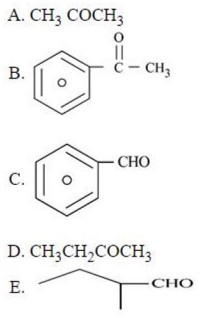
Choose the correct answer from the options given below:
Answer & explanation
Correct answer: option 3
The correct answer is Option (3) → C and E only
Hydrogenation of an acyl chloride over Pd on \( \ce{BaSO4} \) is the Rosenmund reduction. The poisoned catalyst stops the reduction at the aldehyde:
\( \ce{RCOCl + H2} \xrightarrow{\text{Pd-BaSO}_4} \ce{RCHO + HCl} \)
So X must be an aldehyde:
A. acetone — Incorrect. A ketone; the –COCl carbon only gains one H, so it cannot become a ketone.
B. acetophenone — Incorrect. A ketone.
C. benzaldehyde — Correct. Formed from benzoyl chloride.
D. butanone — Incorrect. A ketone.
E. 2-methylpropanal — Correct. Formed from 2-methylpropanoyl chloride.
NCERT (2026-27 edition):
From Acyl Chloride (Acid Chloride)
