
Which of the following combinations are correct?
| Enzyme | Final product formed | |
| A. | Maltase | Glucose |
| B. | Pepsin | Ammonia and \(CO_2\) |
| C. | Urease | Amino acid |
| D. | Zymase | Ethanol and \(CO_2\) |
| E. | Diastase | Glucose |
Choose the correct answer from the options given below:
Answer & explanation
Correct answer: option 2
The correct answer is option 2. A and D only.
A. Maltase \(\rightarrow\) Glucose:
Maltase is an enzyme that belongs to the class of hydrolases, specifically carbohydrases. Its primary function is to catalyze the hydrolysis of maltose, which is a disaccharide composed of two glucose molecules linked together. The reaction catalyzed by maltase can be represented as follows:
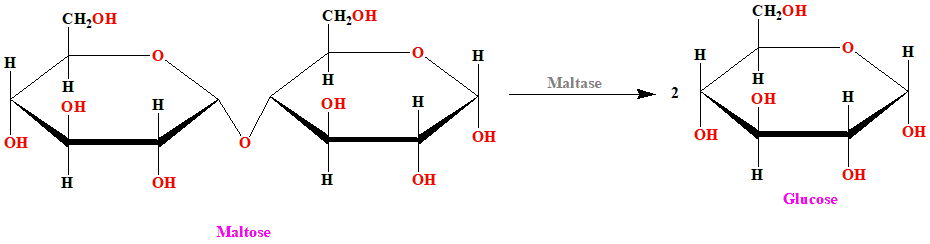
Here, maltase breaks the bond between the two glucose molecules in maltose, resulting in the formation of two separate glucose molecules. So, the final product formed by the action of maltase is glucose.
B. Pepsin \(\rightarrow\) Ammonia and \(CO_2\):
Pepsin is not involved in the production of ammonia and \(CO_2\). Pepsin is a protease enzyme, which means it catalyzes the hydrolysis of proteins into smaller peptide fragments. The typical reaction catalyzed by pepsin can be represented as follows:
\[ Protein \overset{Pepsin}{\longrightarrow} Peptides \]
Here, pepsin breaks down proteins by cleaving peptide bonds between amino acid residues, leading to the formation of peptides.
C. Urease\(\rightarrow\) Amino acid:
Urease is an enzyme that catalyzes the hydrolysis of urea into ammonia and carbon dioxide. The reaction can be represented as:
\[ \text{Urea} \overset{urese}{\longrightarrow} \text{Ammonia} + \text{Carbon Dioxide} \]
In this reaction, urease breaks down urea, which is a waste product in organisms, into two separate compounds: ammonia \((NH_3)\) and carbon dioxide \((CO_2)\). These compounds can then be further processed or eliminated from the organism. Hence the given condition is not correct.
D. Zymase \(\rightarrow\) Ethanol and \(CO_2\):
Zymase is a complex of enzymes found in yeast cells that catalyzes the fermentation of glucose into ethanol and carbon dioxide. The reaction can be represented as:
\[ \underset{Glucose}{C_6H{12}O_6} \overset{Zymase}{\longrightarrow} \text{Ethanol} + \text{Carbon Dioxide} \]
In this reaction, zymase helps convert glucose, a sugar molecule, into ethanol \((C_2H_5-OH)\) and carbon dioxide \((CO_2)\) through the process of fermentation. This reaction is central to processes like brewing, wine making, and bread baking.
E. Diastase \(\rightarrow\) Glucose:
Diastase is a type of amylase enzyme which breaks down carbohydrates like starch into simpler sugars like maltose.
It is found in saliva and malt as well. It transforms starch into maltose and further it changes the maltose formed into glucose. Since starch cannot be digested easily by people with weak pancreas or having pancreatic diseases therefore it is quite helpful in conversion of starch to glucose. It can be found out in barley and plants, saliva and milk as well.
The first function of an enzyme is to hold the substrate for a chemical reaction. Active sites of enzymes hold the substrate molecule in a suitable position. The second function of an enzyme is to provide functional groups that will attack the substrate and carry out chemical reactions. Diastase enzyme thus converts starch to maltose.