
CUETMOCK
  • Pricing
  • Mentors
Log inStart freeStart free mocks→

First test, then trust

Try a free CUET mock test.

Join 5,00,000+ students who rehearsed exam day on the exact NTA screen before sitting CUET. On the web and on Android.

Start free mocks →Get the Android app
CUETMOCK

India's #1 CUET Mock Test Platform. Original NCERT-based questions on the exact NTA exam screen — trusted by 5,00,000+ students since CUET 2022.

Get it onGoogle PlayScan to download the CUETMOCK app

Mock tests

  • CUET mock test series
  • Browse all papers
  • Commerce mocks
  • Humanities (Arts) mocks
  • Science mocks
  • Languages & GAT mocks
  • Free practice questions
  • Pricing

Resources

  • CUET exam guide
  • CUET syllabus
  • Universities accepting CUET
  • Expert blogs
  • News & notifications
  • Webinars & counselling
  • CUET score calculator
  • How we estimate your rank
  • FAQs

Company

  • About us
  • Our leadership & team
  • Our toppers
  • Mentors
  • For schools
  • Contact us
  • Terms
  • Privacy
  • Refund policy

Talk to us

+91 7696 6630 56info@cuetmock.comWhatsApp us

Our other platforms

  • JEE Mock — For IIT-JEE aspirants
  • NEET Mock — For NEET aspirants

Newsletter

Exam updates, study material and offers — no spam.

© 2026 NYC Ventures Pvt. Ltd.

701-702, Royal Business Park, Zirakpur, Punjab - 140603

  • Terms of use
  • Privacy policy
  • Refund policy
  • Contact us

iCUETMOCK is an independent preparation platform, not affiliated with the National Testing Agency (NTA). Always check exam details on the official NTA website.

  • Home
  • Mock tests
  • CUET guide
  • Pricing
  • Log in
Home/Practice questions/General Aptitude Test
General Aptitude TestQuantitative ReasoningData Interpretation & Stats

The given pie-chart represents the percentage of students enrolled in…

The given pie-chart represents the percentage of students enrolled in five different sports. The total number of students is 2800.
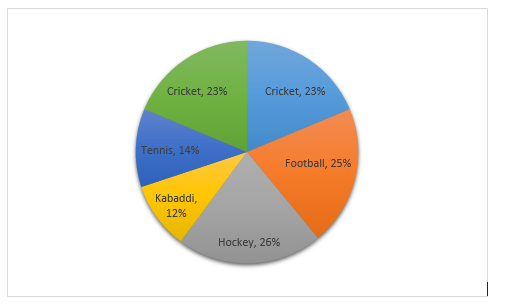
If 24 students playing cricket are shifted to Kabaddi, then find the new ratio of the number of students in Cricket to those in Kabaddi.

Answer & explanation+

Correct answer: option 3

Total number of players = 2800

Initial number of cricket players = \(\frac{23 }{100 }\) × 2800 = 644

Initial number of Kabaddi players = \(\frac{12 }{100 }\) × 2800 = 336

ATQ,

24 students playing cricket are shifted to Kabaddi

Now , Number of students in cricket = 644 - 24 = 620

Number of students in Kabaddi = 336 + 24 = 360

Ratio of , Number of students in cricket  :   Number of students in kabaddi

 620  :   360

  31   :     18


Advertisement

Practise more on Quantitative Reasoning

Chapter-wise mocks on the real NTA exam screen, with solutions and your rank. Your first mocks are free.

Start free mocks →

Advertisement

Next questions

  1. Which of the following professions do NOT come under quinary activitites ?Geography · Fundamentals of Human Geography: Tertiary and Quaternary Activities
  2. Which of the following is a disease caused by protozoa?General Aptitude Test · General Knowledge
  3. In October 2024, a Cherenkov telescope- largest in Asia, designed to study cosmic events and unravel mysteries surrounding black holes, was…General Aptitude Test · Current Affairs
  4. Which type of trade is done by two countries with each other ?Geography · Fundamentals of Human Geography: International Trade
  5. What will be the value of cosx cosecx - sinx secxGeneral Aptitude Test · Quantitative Reasoning
  6. Fill in the blank with the most appropriate word from the given options:-Social legislature, ___ laws for societal welfare, represent the l…English · Grammar: Conjunction
  7. At the time of Reconstitution, Goodwill already appearing in books of accounts is distributed among partners in....Accountancy Part A · Admission of a Partner
  8. If 14 : 30 :: 7 : x, then what is the value of x?General Aptitude Test · Numerical Ability
  9. What is co-evolution?Biology · Organisms and Populations
  10. Which of the following industry uses more power and is located close to the source of the energy supply ?Geography · Fundamentals of Human Geography: Secondary Activities