Read the passage carefully and answer the questions.
The osmotic pressure is one of the four colligative properties which depends on the number of particles of solute in the solution, irrespective of their nature. The osmotic pressure is equal to the product of concentration, gas constant and temperature. It is the most commonly used property for the determination of the molar mass of biomolecules. In many situations, the molecules get dissociated or associated when they are dissolved in a solvent, thereby changing the number of molecules in the solution. As a result, an abnormal molecular mass is obtained. The extent of dissociation or association is given by van't Hoff factor (i), which is the ratio of normal molar mass to abnormal molar mass. It is related with the degree of association or ionization. The introduction of van't Hoff factor in the osmotic pressure equation modifies the equation.
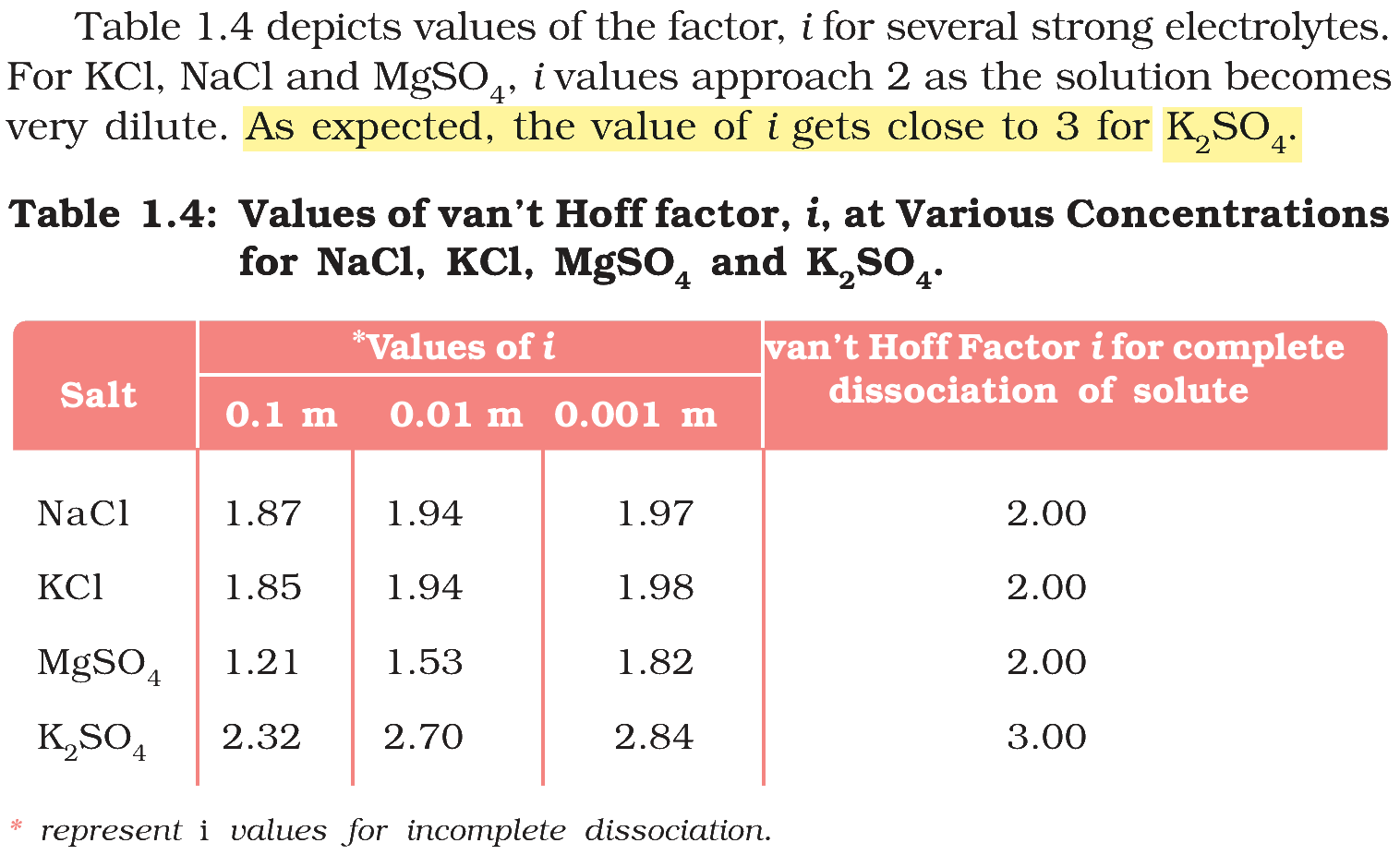
What is the value of the van't Hoff factor for \( NaCl, K_2SO_4 \) and \( KCl \), respectively?
Answer & explanation
Correct answer: option 4
The correct answer is Option (4) → 2, 3 and 2
The van’t Hoff factor i is the number of moles of particles present after dissociation (or association) divided by the number of moles of solute taken. For a strong electrolyte that dissociates completely, i is just the number of ions given by one formula unit.
\( \displaystyle \ce{NaCl -> Na+ + Cl-} \quad (1 + 1 = 2\ \text{ions},\ i = 2) \)
\( \displaystyle \ce{K2SO4 -> 2K+ + SO4^2-} \quad (2 + 1 = 3\ \text{ions},\ i = 3) \)
\( \displaystyle \ce{KCl -> K+ + Cl-} \quad (1 + 1 = 2\ \text{ions},\ i = 2) \)
So the values are 2, 3 and 2. In real solutions the measured values are a little lower and approach these limits only on dilution, because the ions attract one another.
Shortcut: NaCl gives two ions, so its i cannot be 1; only Option (4) starts with 2.
NCERT (2026-27 edition):
Abnormal Molar Masses – …