Match List-I with List-II
List-I
(A) Partner pays the dissolution expenses and firm agrees to reimburse
(B) Partner bears the dissolution expenses on his own
(C) Firm bears the dissolution expenses
(D) Firm has given the fixed sum to a partner for bearing dissolution expenses irrespective of actual amount
List-II
(I) Debit Realisation Account and Credit Bank/Cash Account
(II) Excess shall be borne by the partner
(III) No entry
(IV) Debit Realisation Account and Credit Partner's Capital Account
Choose the correct answer from the options given below:
Answer & explanation
Correct answer: option 3
The correct answer is Option (3) → (A) - (IV), (B) - (III), (C) - (I), (D) - (II)
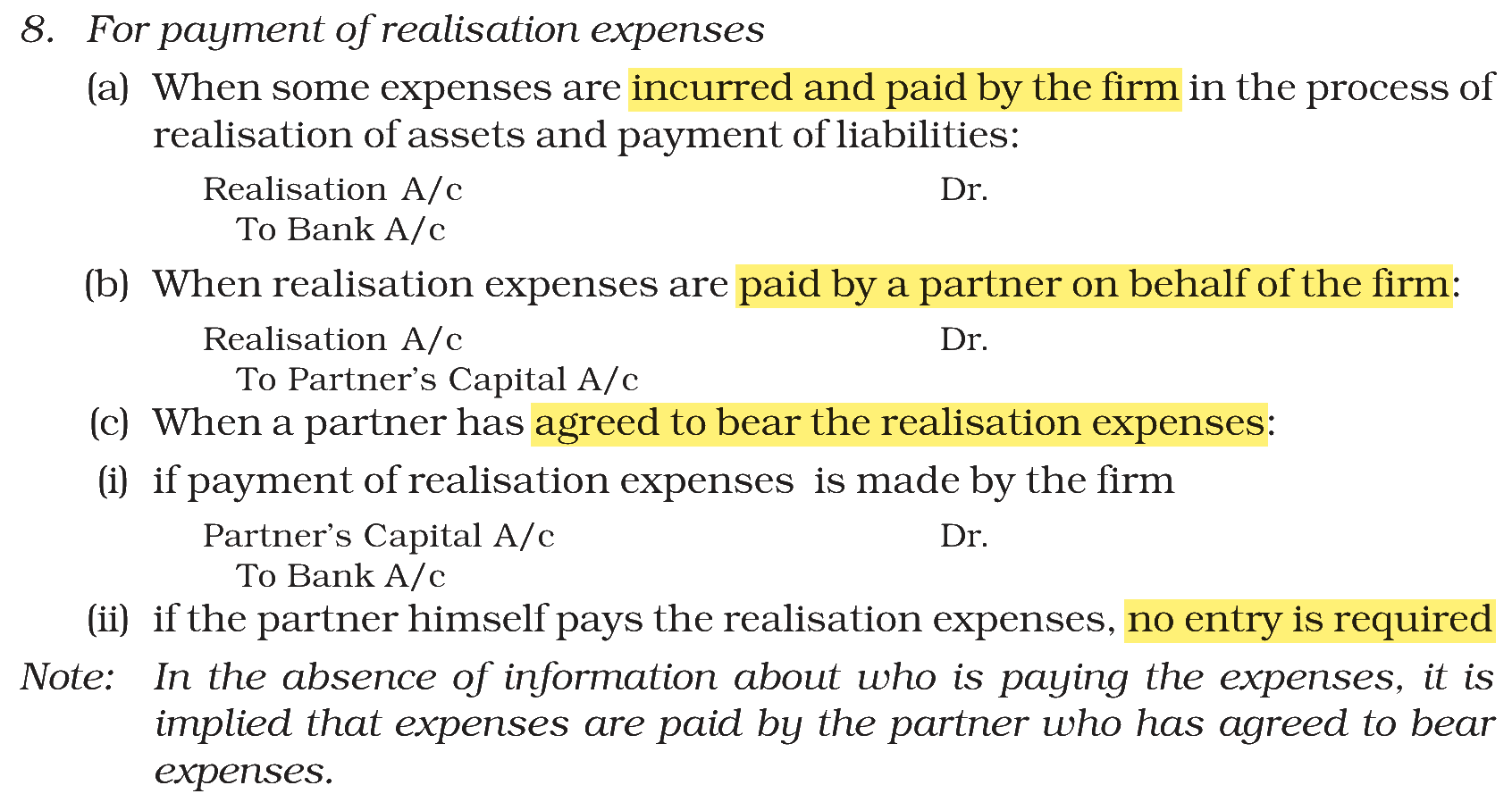
Dissolution expenses are always the firm’s expense and go to the debit of Realisation Account, unless a partner has agreed to bear them himself. What is credited depends on who pays.
(A) Partner pays the dissolution expenses and firm agrees to reimburse — this matches (IV) Debit Realisation Account and Credit Partner’s Capital Account. The expense is the firm’s, and the partner who paid it is repaid through his capital account.
(B) Partner bears the dissolution expenses on his own — this matches (III) No entry. Neither the firm’s cash nor its accounts are touched, so nothing is recorded.
(C) Firm bears the dissolution expenses — this matches (I) Debit Realisation Account and Credit Bank/Cash Account. The firm pays from its own cash, so Bank/Cash is credited.
(D) Firm has given the fixed sum to a partner for bearing dissolution expenses irrespective of actual amount — this matches (II) Excess shall be borne by the partner. The firm’s cost is fixed at the agreed sum, so any actual expense above it falls on that partner.
NCERT (2026-27 edition):
|