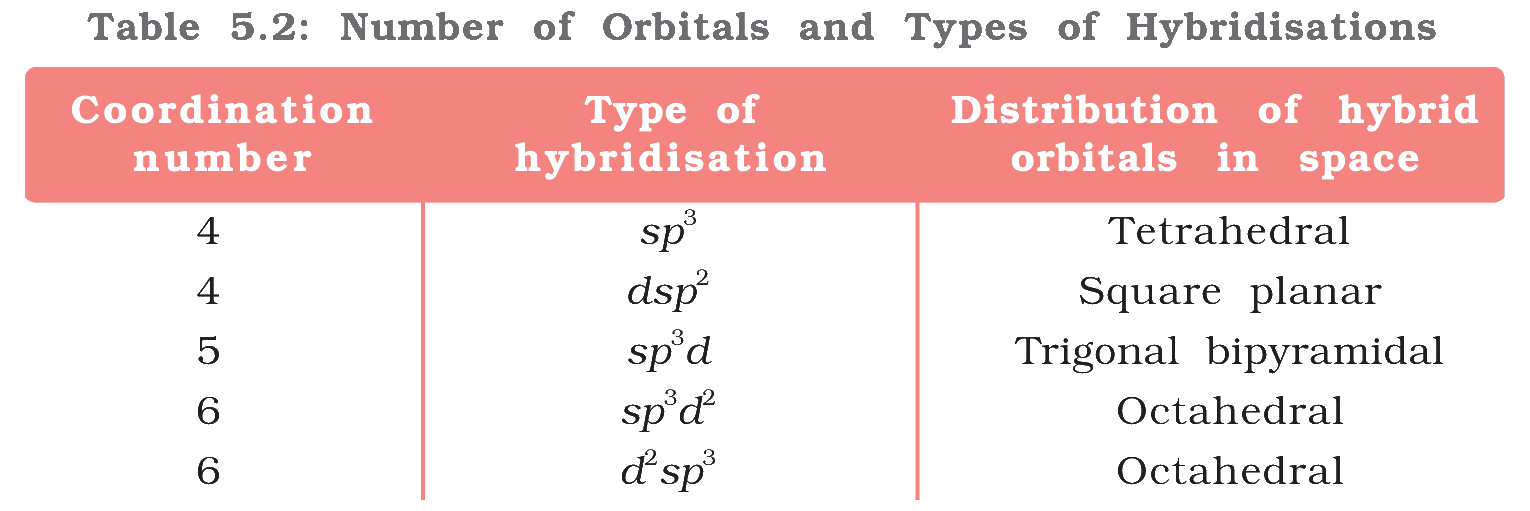
To explain bonding in complexes, the valence bond theory was proposed by Linus Pauling. The main postulates of VB theory are as follows:
(v) In the presence of strong ligands such as CN−, NO, CO, the d-electrons are rearranged vacating some d-orbitals (only when there are more than three d-electrons) which can then take part in hybridisation.
(vi) In the presence of weak ligands such as F−, Cl−, H2O, etc., the d-electrons are not rearranged.
(vii) The d-orbitals involved in hybridisation may be either (n−1)d orbitals or outer d-orbitals.
The complexes formed by the involvement of (n−1)d orbitals in hybridisation are called inner orbital complexes or low spin complexes. The complexes formed by the involvement of outer d-orbitals are called outer orbital complexes or high spin complexes.
(viii) Each ligand contains a lone pair of electrons. A dative bond is formed by the overlap of a vacant hybrid orbital of metal ion and a filled orbital of ligand.
(ix) The complex will be paramagnetic, if unpaired electrons are present; otherwise it is diamagnetic.
Consider the following statements about the valence bond theory of coordination compounds.
(A) For a coordination number of 5, the type of hybridisation is sp3d and the hybrid orbitals have a trigonal bipyramidal distribution in space.
(B) dsp2 hybridisation gives a tetrahedral distribution of hybrid orbitals in space.
(C) It is usually possible to predict the geometry of a complex from the knowledge of its colour on the basis of the valence bond theory.
(D) The hybrid orbitals do not actually exist; hybridisation is a mathematical manipulation of wave equation for the atomic orbitals involved.
Which of the statements given above are correct? Choose the correct answer from the options given below:
Answer & explanation
Correct answer: option 1
The correct answer is Option (1) → (A) and (D) only
In the valence bond theory, the metal ion uses a set of hybrid orbitals of definite geometry; the ligands donate electron pairs into these orbitals.
(A) For a coordination number of 5, the type of hybridisation is sp3d and the hybrid orbitals have a trigonal bipyramidal distribution in space. — True. Five hybrid orbitals (one s, three p, one d) point to the corners of a trigonal bipyramid.
(B) dsp2 hybridisation gives a tetrahedral distribution of hybrid orbitals in space. — False. dsp2 gives a square planar distribution; the tetrahedral set is sp3. Both have coordination number 4.
(C) It is usually possible to predict the geometry of a complex from the knowledge of its colour on the basis of the valence bond theory. — False. The geometry is predicted from the magnetic behaviour (the number of unpaired electrons). The valence bond theory does not explain colour at all.
(D) The hybrid orbitals do not actually exist; hybridisation is a mathematical manipulation of wave equation for the atomic orbitals involved. — True. Hybrid orbitals are a mathematical model used to describe the bonding, not real orbitals.
NCERT (2026-27 edition):
5.5.1 Valence Bond Theory – “It is usually possible to predict the geometry of a complex from the knowledge of its magnetic behaviour on the basis of the valence bond theory.”
“It is important to note that the hybrid orbitals do not actually exist. In fact, hybridisation is a mathematical manipulation of wave equation for the atomic orbitals involved.”
5.5.3 Limitations of Valence Bond Theory – “(iii) It does not explain the colour exhibited by coordination compounds.”