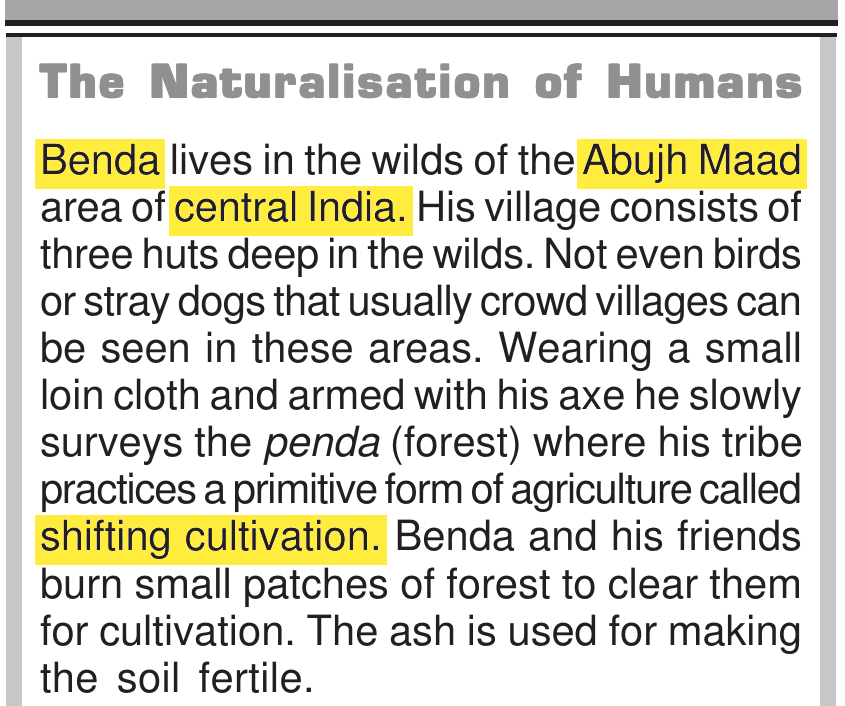
Benda's life in a tribal forested area of central India exhibits which of the following concepts of man-environment relationship?
Answer & explanation
Correct answer: option 1
The correct answer is Option (1) → Determinism
Benda lives deep in the forest of the Abujh Maad area. His tribe practises shifting cultivation, and he thanks the spirit of the forest for water. People with very low technology depend directly on nature and follow its dictates. This kind of human-nature interaction is environmental determinism.
Option (1) Determinism — Correct. In the early stages, humans with very low technology adapted to the dictates of nature, feared its fury and worshipped it. Benda’s life is an example of such a naturalised human.
Option (2) Neo-determinism — Incorrect. Griffith Taylor’s middle path between determinism and possibilism, also called ‘stop and go determinism’. Humans conquer nature by obeying it.
Option (3) Probabilism — Incorrect. It is not one of the ideas of human-nature interaction in this chapter, which are environmental determinism, possibilism and neo-determinism.
Option (4) Possibilism — Incorrect. With better technology, people move from a state of necessity to a state of freedom and create possibilities, and nature gets humanised. Benda’s life shows the opposite.
NCERT (2026-27): “Technology indicates the level of cultural development of society. … In the early stages of their interaction with their natural environment humans were greatly influenced by it. They adapted to the dictates of Nature. This is so because the level of technology was very low and the stage of human social development was also primitive. This type of interaction between primitive human society and strong forces of nature was termed as environmental determinism.”
Box: The Naturalisation of Humans (part) |