Assertion (A): If the price of an input rises and, at the same time, consumers’ incomes rise, the equilibrium price of a normal good must rise.
Reason (R): Supply shifts leftward and demand shifts rightward, and this combination of shifts always raises the equilibrium price.
Answer & explanation
Correct answer: option 1
The correct answer is Option (1) → Both (A) and (R) are true and (R) is the correct explanation of (A).
Assertion (A): If the price of an input rises and, at the same time, consumers’ incomes rise, the equilibrium price of a normal good must rise. — True. A dearer input shifts supply left. Higher income raises the demand for a normal good, so demand shifts right. Both push the price up.
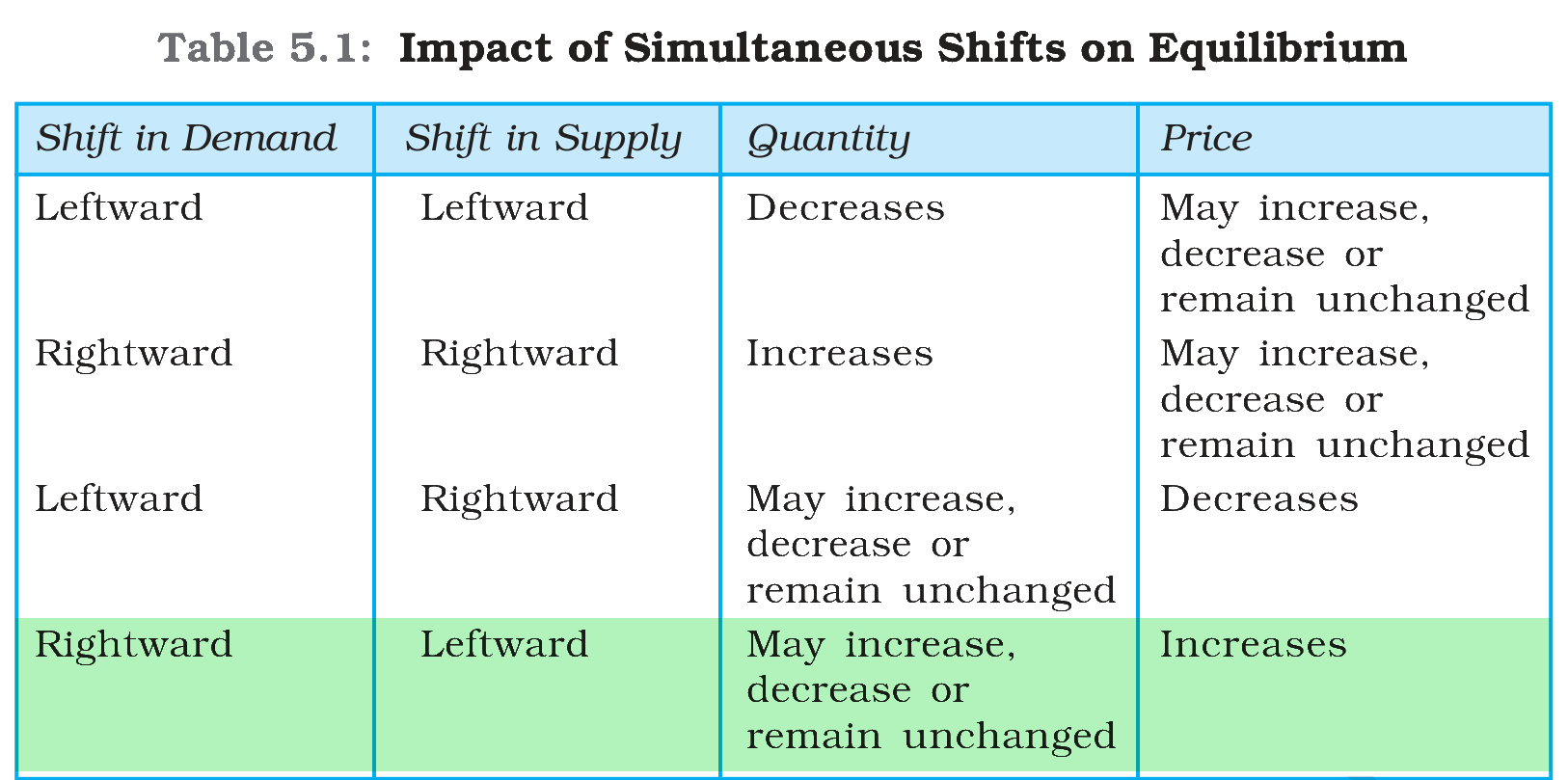
Reason (R): Supply shifts leftward and demand shifts rightward, and this combination of shifts always raises the equilibrium price. — True. When demand shifts right and supply shifts left, the price always rises. Only the change in quantity depends on the size of the shifts.
Why R explains A?
A names two events. R tells which way each curve moves and that this pair of shifts raises the price in every case. So the price in A must rise, whatever the size of the two shifts.
NCERT (2026-27): “Demand Shift … Here we consider the example of a normal good like clothes, the demand for which increases with increase in income of consumers, thereby causing a rightward shift in the demand curve. …” “Supply Shift … Let us consider a situation where all other things remaining constant, there is an increase in the price of an input used in the production of a commodity. This will increase the marginal cost of production of the firms using this input. Therefore, at each price, the market supply will be less than before. Hence, the supply curve shifts leftward. …” “Simultaneous Shifts of Demand and Supply … In the first two cases which are shown in the first two rows of the table, the impact on equilibrium quantity is unambiguous but the equilibrium price may change, if at all, in either direction depending on the magnitudes of shifts. In the next two cases, shown in the last two rows of the table, the effect on price is unambiguous whereas effect on quantity depends on the magnitude of shifts in the two curves.”
|