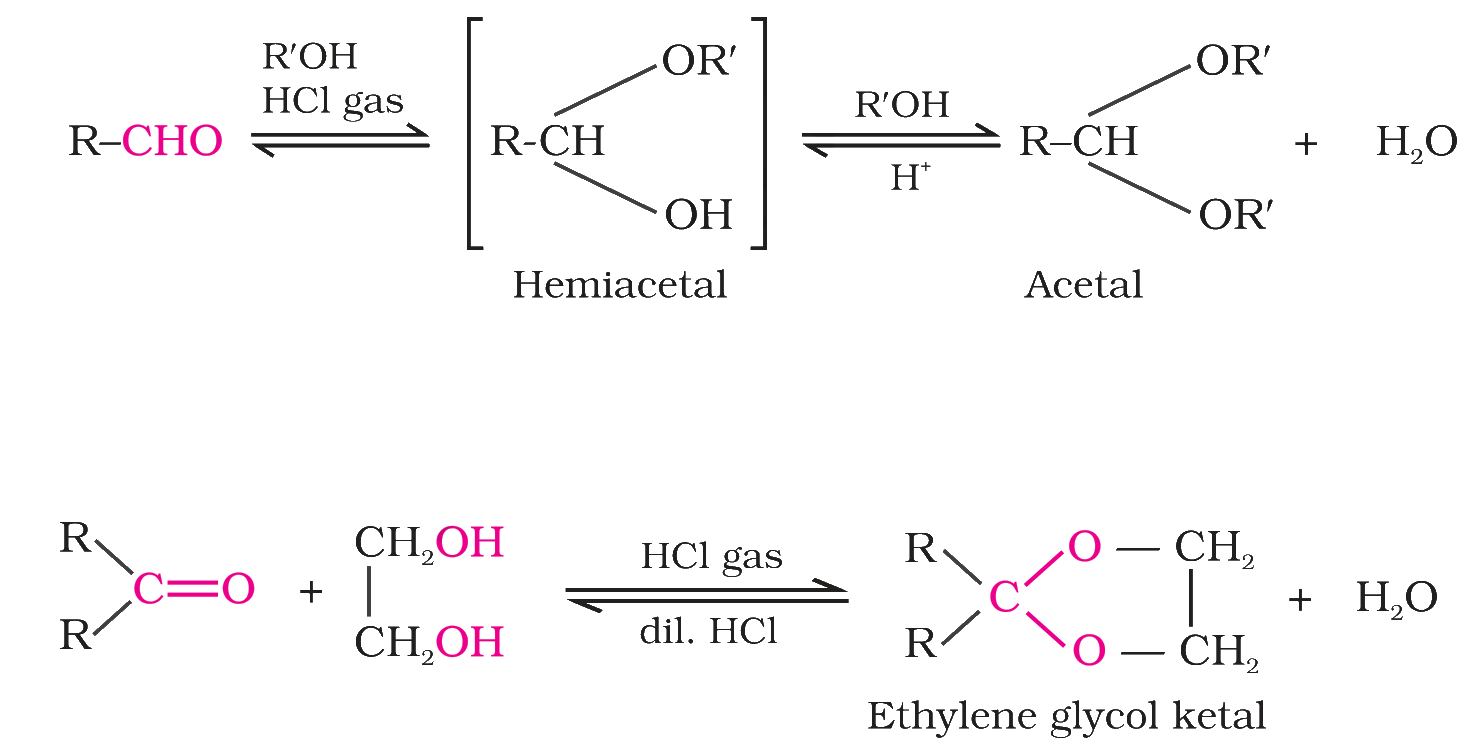
Consider the following statements about the reaction of aldehydes and ketones with alcohols.
(A) Aldehydes react with one equivalent of a monohydric alcohol in the presence of dry hydrogen chloride to give alkoxyalcohol intermediates known as hemiacetals.
(B) A hemiacetal reacts with one more molecule of the alcohol to give a gem-dihydroxy compound known as an acetal.
(C) Dry hydrogen chloride protonates the oxygen of the carbonyl compound and so increases the electrophilicity of the carbonyl carbon.
(D) Acetals and ketals are hydrolysed with aqueous alkalies to give the corresponding aldehydes and ketones.
Which of the statements given above are correct? Choose the correct answer from the options given below:
Answer & explanation
Correct answer: option 3
The correct answer is Option (3) → (A) and (C) only
An alcohol is a weak nucleophile, so the addition needs dry HCl as catalyst. The first alcohol molecule gives a hemiacetal; a second molecule replaces its OH to give an acetal. Taking ethanal and methanol as an example:
\( \displaystyle \ce{CH3CHO + CH3OH} \xrightarrow{\text{dry HCl}} \ce{CH3CH(OH)OCH3} \)
\( \displaystyle \ce{CH3CH(OH)OCH3 + CH3OH} \xrightarrow{\ce{H^+}} \ce{CH3CH(OCH3)2 + H2O} \)
(A) Aldehydes react with one equivalent of a monohydric alcohol in the presence of dry hydrogen chloride to give alkoxyalcohol intermediates known as hemiacetals. — True. The hemiacetal carries one OR group and one OH group on the same carbon, as in \( \ce{CH3CH(OH)OCH3} \).
(B) A hemiacetal reacts with one more molecule of the alcohol to give a gem-dihydroxy compound known as an acetal. — False. The acetal is a gem-dialkoxy compound: both groups on the carbon are OR groups, as in \( \ce{CH3CH(OCH3)2} \), not OH groups.
(C) Dry hydrogen chloride protonates the oxygen of the carbonyl compound and so increases the electrophilicity of the carbonyl carbon. — True. The protonated carbonyl carbon carries more positive charge, so the weak nucleophile (the alcohol or ethylene glycol) can attack it.
(D) Acetals and ketals are hydrolysed with aqueous alkalies to give the corresponding aldehydes and ketones. — False. The hydrolysis is done with aqueous mineral acids:
\( \displaystyle \ce{CH3CH(OCH3)2 + H2O} \xrightarrow{\ce{H3O^+}} \ce{CH3CHO + 2CH3OH} \)
NCERT (2026-27 edition):
8.4 Chemical Reactions – “(d) Addition of alcohols: Aldehydes react with one equivalent of monohydric alcohol in the presence of dry hydrogen chloride to yield alkoxyalcohol intermediate, known as hemiacetals, which further react with one more molecule of alcohol to give a gem-dialkoxy compound known as acetal as shown in the reaction.”
“…Dry hydrogen chloride protonates the oxygen of the carbonyl compounds and therefore, increases the electrophilicity of the carbonyl carbon facilitating the nucleophilic attack of ethylene glycol. Acetals and ketals are hydrolysed with aqueous mineral acids to yield corresponding aldehydes and ketones respectively.”