The metre bridge wire is made of alloys such as nichrome because they have:
Answer & explanation
Correct answer: option 3
The correct answer is Option (3) → low temperature coefficient of resistance and high resistivity
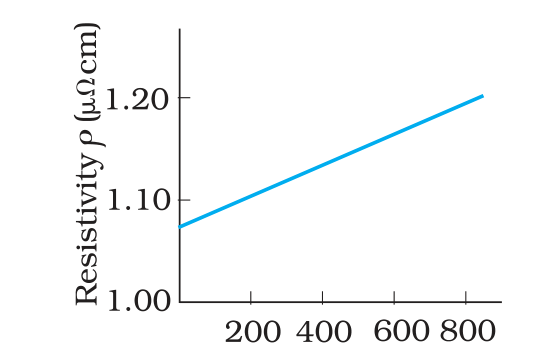
The metre bridge compares resistances by the balance point on a uniform wire, so the wire’s resistance must stay constant while the current flows. Heating by the current would change the resistance of a pure metal, since its resistance rises with temperature. An alloy such as nichrome has a very small temperature coefficient of resistance, so the ratio of the two lengths stays steady. It also has a high resistivity, so a wire only one metre long still has an appreciable resistance, and a fixed length of it gives a usable potential drop and a sharp balance point.
NCERT (2026-27):
Temperature Dependence of Resistivity – “… Some materials like Nichrome (which is an alloy of nickel, iron and chromium) exhibit a very weak dependence of resistivity with temperature (Fig. 3.9). Manganin and constantan have similar properties. These materials are thus widely used in wire bound standard resistors since their resistance values would change very little with temperatures.”