
CUETMOCK
  • Pricing
  • Mentors
Log inStart freeStart free mocks→

First test, then trust

Try a free CUET mock test.

Join 5,00,000+ students who rehearsed exam day on the exact NTA screen before sitting CUET. On the web and on Android.

Start free mocks →Get the Android app
CUETMOCK

India's #1 CUET Mock Test Platform. Original NCERT-based questions on the exact NTA exam screen — trusted by 5,00,000+ students since CUET 2022.

Get it onGoogle PlayScan to download the CUETMOCK app

Mock tests

  • CUET mock test series
  • Commerce mocks
  • Humanities (Arts) mocks
  • Science mocks
  • Languages & GAT mocks
  • Free practice questions
  • Pricing

Resources

  • CUET exam guide
  • CUET syllabus
  • Universities accepting CUET
  • Expert blogs
  • News & notifications
  • Webinars & counselling
  • CUET score calculator
  • How we estimate your rank
  • FAQs

Company

  • About us
  • Our leadership & team
  • Our toppers
  • Mentors
  • For schools
  • Contact us
  • Terms
  • Privacy
  • Refund policy

Talk to us

+91 7696 6630 56info@cuetmock.comWhatsApp us

Our other platforms

  • JEE Mock — For IIT-JEE aspirants
  • NEET Mock — For NEET aspirants

Newsletter

Exam updates, study material and offers — no spam.

© 2026 NYC Ventures Pvt. Ltd.

701-702, Royal Business Park, Zirakpur, Punjab - 140603

  • Terms of use
  • Privacy policy
  • Refund policy
  • Contact us

iCUETMOCK is an independent preparation platform, not affiliated with the National Testing Agency (NTA). Always check exam details on the official NTA website.

  • Home
  • Mock tests
  • CUET guide
  • Pricing
  • Log in
Home/Practice questions/Chemistry
ChemistryOrganic: Aldehydes, Ketones and Carboxylic Acids

Phthalic acid is treated with ammonia and the product is strongly hea…

Phthalic acid is treated with ammonia and the product is strongly heated. What is the final product?

Answer & explanation+

Correct answer: option 3

The correct answer is Option (3) → Phthalimide

A carboxylic acid and ammonia first give an ammonium salt; heating then removes water to give an amide. Phthalic acid (benzene-1,2-dicarboxylic acid) has two –COOH groups, so it goes one step further:

  • With ammonia: ammonium phthalate is formed.

        \( \displaystyle \ce{C6H4(COOH)2 + 2NH3} \rightleftharpoons \ce{C6H4(COONH4)2} \)

  • On heating: loss of two water molecules gives phthalamide.

        \( \displaystyle \ce{C6H4(COONH4)2} \xrightarrow{\Delta} \ce{C6H4(CONH2)2 + 2H2O} \)

  • On strong heating: the two amide groups lose one molecule of ammonia and close a ring, giving phthalimide.

        \( \displaystyle \ce{C6H4(CONH2)2} \xrightarrow{\text{strong heating}} \ce{C6H4(CO)2NH + NH3} \)

Why the other options are incorrect

Option (1) Ammonium phthalate — Incorrect. It is the first product, formed before any heating; strong heating changes it further.

Option (2) Acetamide — Incorrect. Acetamide comes from ethanoic acid and ammonia (through ammonium acetate), not from phthalic acid.

Option (4) Benzamide — Incorrect. Benzamide comes from benzoic acid, which has only one –COOH group.

NCERT (2026-27 edition):
8.9.2 Reactions Involving Cleavage of C–OH Bond – “4. Reaction with ammonia
Carboxylic acids react with ammonia to give ammonium salt which on further heating at high temperature give amides.”
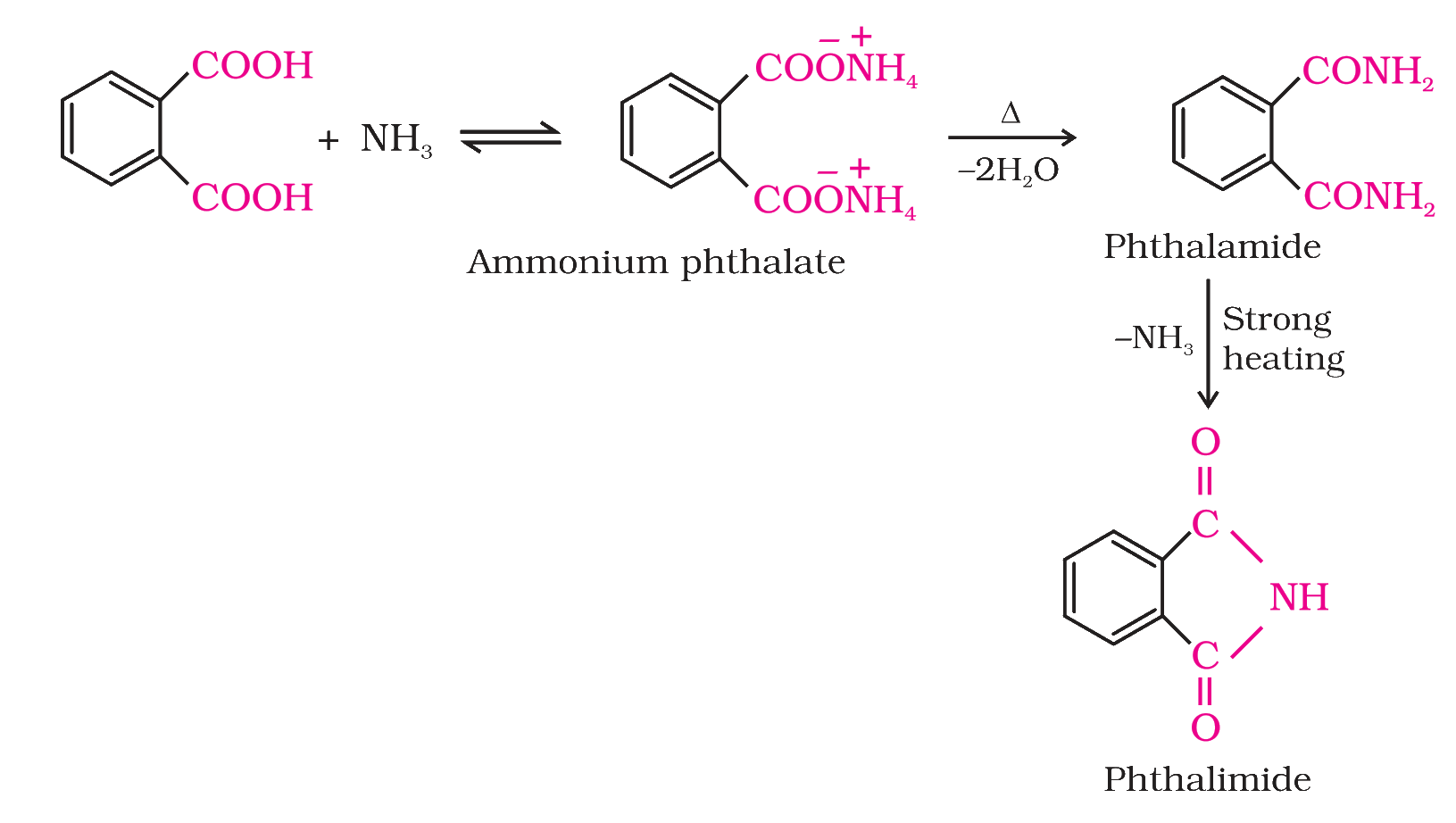
Textbook extract

Advertisement

Practise more on Organic: Aldehydes, Ketones and Carboxylic Acids

Chapter-wise mocks on the real NTA exam screen, with solutions and your rank. Your first mocks are free.

Start free mocks →

Advertisement

Next questions

  1. Choose the equation that represents the calculation of population density at time t+1, given the following representations: If natality is…Biology · Organisms and Populations
  2. Given below are two statements: one is labelled as Assertion (A) and the other is labelled as Reason (R).Assertion (A): A person jumping ou…General Aptitude Test · General Knowledge
  3. How many squares are there in the given figure?General Aptitude Test · Verbal Reasoning
  4. Match List-I with List-II.List-I (Verbs)List-II (Meanings)(A) ensure(I) to make something new that did not exist before(B) insure(II) to pa…English · Grammar: Verb
  5. Which of the following statements are true regarding old social movements? 1. The old social movements clearly saw reorganisation of power…Sociology · Social Change and Development in India: Social Movements
  6. Match List 1 with List 2: List- 1 (Stones) List- 2 (Description) (A) Steatite (I) Its beads acquired red colour by firing the yellow raw ma…History · Ancient India: Bricks, Beads and Bones
  7. Which of the following statements are true with reference to the variation of conductivity and molar conductivity as concentration changes?…Chemistry · Physical: Electro Chemistry
  8. 'विशेषणों के विशेषण' को क्या कहते हैं?Hindi · व्याकरण - विशेषण
  9. For transformation, micro-particles coated with DNA to be bombarded with gene gun are made up of which of the following metals?Biology · Biotechnology -Principles and Processes
  10. Evaluate ∫limits_0^2 (x^2 + 3) dxMaths. Section B1 · Definite Integration