
Choose the equation that represents the calculation of population density at time t+1, given the following representations:
If natality is represented by B
If mortality is represented by D
If immigration is represented by I
If emigration is represented by E
If population density is represented by N
Answer & explanation
Correct answer: option 2
The correct answer is Option (2) → Nt+1 = Nt + [(B + I) – (D + E)]
Population density changes through four processes. Two of them add individuals: natality (B, births) and immigration (I, individuals coming in). Two remove individuals: mortality (D, deaths) and emigration (E, individuals leaving).
- Individuals added in the period: B + I
- Individuals lost in the period: D + E
- Density at time t + 1 = density at time t + additions − losses: Nt+1 = Nt + [(B + I) − (D + E)]
Option (1) Nt+1 = Nt – [(B + I) – (D + E)] — Incorrect. It subtracts the net change. Then a rise in births or immigrants would lower the population, which is wrong.
Option (2) Nt+1 = Nt + [(B + I) – (D + E)] — Correct. It adds the gains (B + I) and takes away the losses (D + E). This is the book’s equation.
Option (3) Nt+1 = Nt + [(B + I) + (D + E)] — Incorrect. It adds deaths and emigrants as well. Losses cannot make a population grow.
Option (4) Nt+1 = Nt – [(B + I) + (D + E)] — Incorrect. It subtracts everything. Births and immigrants would then reduce the population.
NCERT Extract:
Population Growth – “… So, if N is the population density at time t, then its density at time t +1 is Nt+1 = Nt + [(B + I) – (D + E)] You can see from the above equation (Fig. 11.2) that population density will increase if the number of births plus the number of immigrants (B + I) is more than the number of deaths plus the number of emigrants (D + E).”
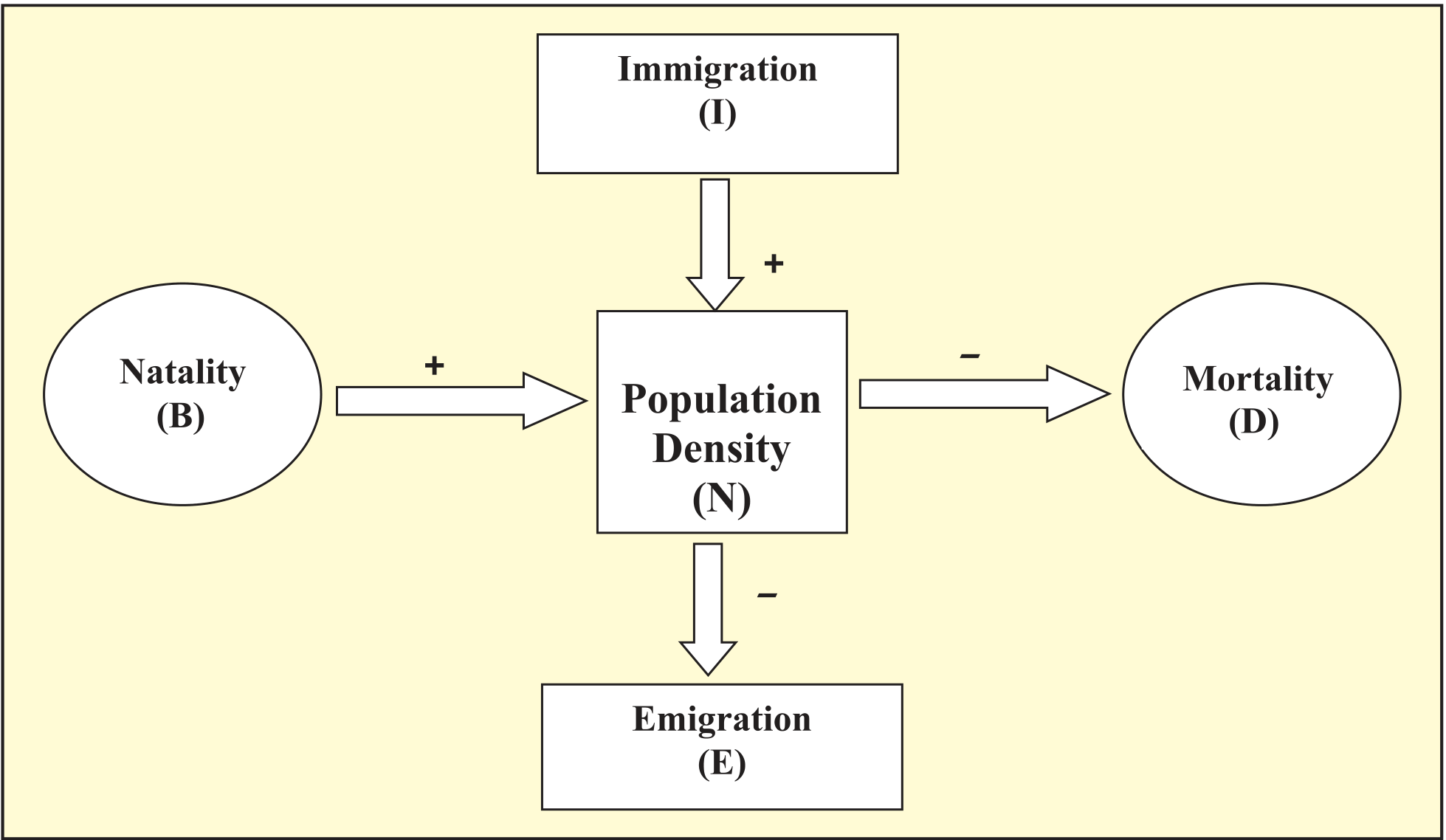
Figure 11.2