
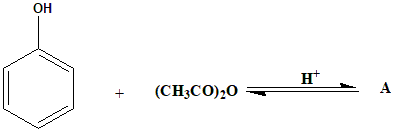
\(A\) will be
Answer & explanation
Correct answer: option 1
The correct answer is Option (1) → Phenyl acetate (C6H5OCOCH3)
Phenols react with carboxylic acids, acid chlorides and acid anhydrides to form esters (esterification). With acetic anhydride and a little acid, the H of the phenolic –OH is replaced by an acetyl group (acetylation):
\( \ce{C6H5OH + (CH3CO)2O <=>[H+] C6H5OCOCH3 + CH3COOH} \)
A is phenyl acetate (phenyl ethanoate). The reaction is reversible, which is why the equation is drawn with an equilibrium arrow.
Why the other options are incorrect
Option (2) o-hydroxyacetophenone — Incorrect. The \( \ce{COCH3} \) group on the ring would need a C-acylation (Friedel-Crafts with \( \ce{AlCl3} \), or the Fries rearrangement), not acetylation of OH.
Option (3) o-cresol — Incorrect. It has a \( \ce{CH3} \) on the ring; acetic anhydride does not methylate the ring.
Option (4) p-hydroxyacetophenone — Incorrect. Again a ring-acylated product, not formed under these conditions.
NCERT (2026-27 edition):
Esterification – “Alcohols and phenols react with carboxylic acids, acid chlorides and acid anhydrides to form esters. … The reaction with carboxylic acid and acid anhydride is carried out in the presence of a small amount of concentrated sulphuric acid. The reaction is reversible … The introduction of acetyl (CH3CO) group in alcohols or phenols is known as acetylation.”