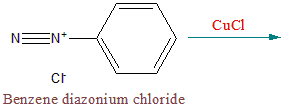
Identify the product of the given reaction.
Answer & explanation
Correct answer: option 2
The correct answer is Option (2) → Chlorobenzene
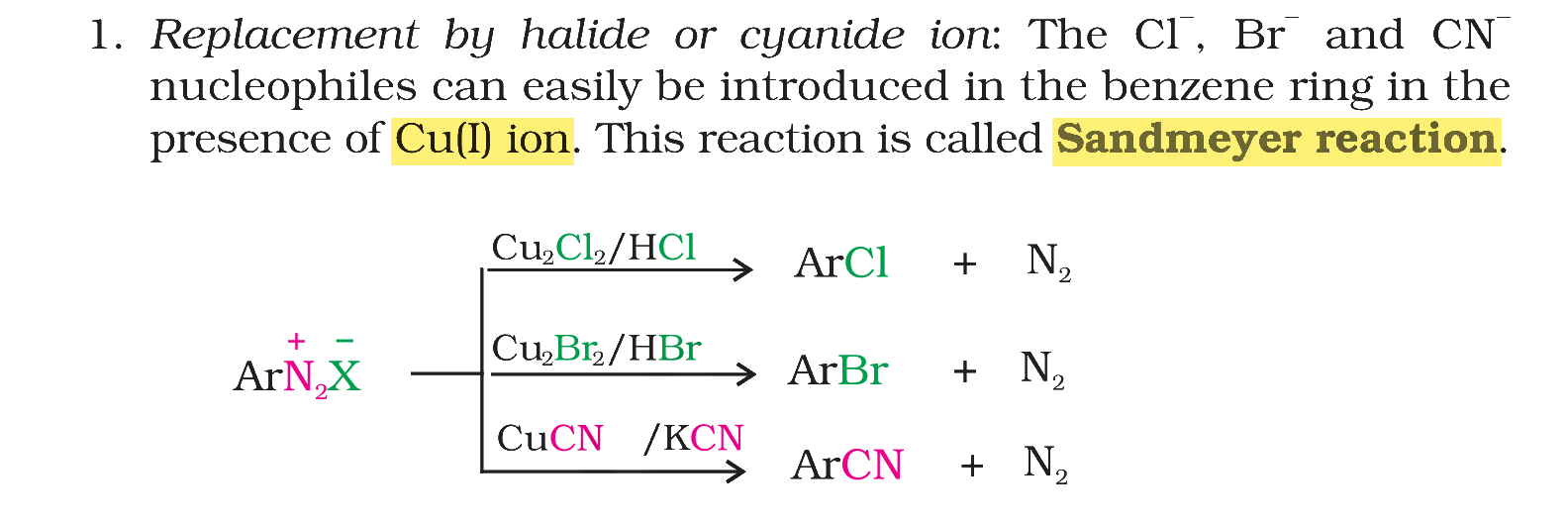
In the Sandmeyer reaction, the diazonium group of an arenediazonium salt is replaced by –Cl, –Br or –CN in the presence of the Cu(I) ion. Nitrogen gas is lost, and one group takes the place of the one diazonium group.
Benzenediazonium chloride with \( \ce{CuCl} \) (in \( \ce{HCl} \)) gives chlorobenzene:
\( \displaystyle \ce{C6H5N2^+Cl^-} \xrightarrow{\ce{CuCl/HCl}} \ce{C6H5Cl + N2 ^} \)
Why the other options are incorrect
Option (1) Benzene — Incorrect. Benzene forms when the diazonium group is replaced by H, using a mild reducing agent such as hypophosphorous acid, not CuCl:
\( \displaystyle \ce{C6H5N2^+Cl^- + H3PO2 + H2O -> C6H6 + N2 + H3PO3 + HCl} \)
Option (3) 1,2-Dichlorobenzene — Incorrect.
The salt has only one diazonium group, so only one Cl enters.
The dichlorobenzenes are made by chlorinating chlorobenzene with \( \ce{Cl2} \) and anhydrous \( \ce{FeCl3} \), which gives the ortho and para isomers:
\( \displaystyle \ce{C6H5Cl + Cl2} \xrightarrow{\text{anhyd. }\ce{FeCl3}} \ce{ClC6H4Cl + HCl} \)
Option (4) 1,4-Dichlorobenzene — Incorrect. This is the para product of the same chlorination of chlorobenzene; the Sandmeyer reaction puts a single Cl on the ring.
NCERT (2026-27 edition):
Reactions involving displacement of nitrogen