
Match List-I with List-II
| List-I | List-II |
| (Name of the Compounds) | (Chemical Structures) |
| (A) Gluconic acid | (I) 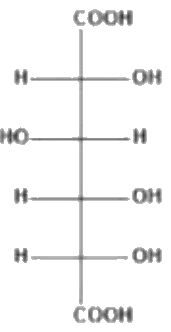 |
| (B) Fructose | (II) 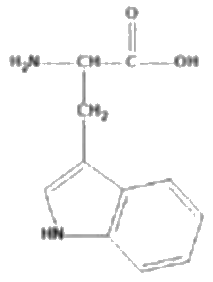 |
| (C) Tryptophan | (III) 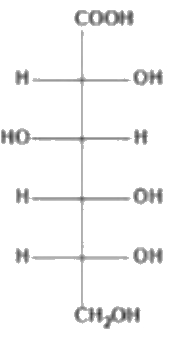 |
| (D) Saccharic acid | (IV) 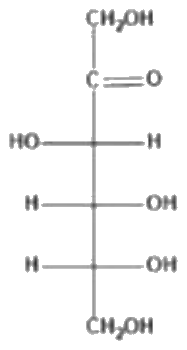 |
Choose the correct answer from the options given below:
Answer & explanation
Correct answer: option 4
The correct answer is Option (4) → (A) - (III), (B) - (IV), (C) - (II), (D) - (I)
Three of the structures are six-carbon chains related to glucose; they differ only in the groups at the two ends of the chain. Glucose has –CHO at C1 and –\( \ce{CH2OH} \) at C6. A mild oxidising agent changes only the –CHO group, a strong one changes both ends, and a ketohexose carries its C=O group at C2.
(A) Gluconic acid — This matches structure III. Bromine water oxidises only the –CHO group of glucose to –COOH, so the chain has –COOH at the top and –\( \ce{CH2OH} \) at the bottom.
\( \displaystyle \ce{CHO-(CHOH)4-CH2OH} \xrightarrow{\ce{Br2}\text{ water}} \ce{COOH-(CHOH)4-CH2OH} \)
(B) Fructose — This matches structure IV. Fructose is a ketohexose: the C=O group is at C2, and both ends of the chain are –\( \ce{CH2OH} \) groups.
(C) Tryptophan — This matches structure II. It is an α-amino acid, \( \ce{H2N-CH(R)-COOH} \), whose side chain R is a \( \ce{CH2} \) group attached to an indole ring.
(D) Saccharic acid — This matches structure I. Nitric acid oxidises both the –CHO group and the primary –\( \ce{CH2OH} \) group of glucose, so the chain has –COOH at both ends.
\( \displaystyle \ce{CHO-(CHOH)4-CH2OH} \xrightarrow{\ce{HNO3}} \ce{COOH-(CHOH)4-COOH} \)
Shortcut: The pair (A)–(III) appears in Options (3) and (4), and (B)–(IV) then leaves only Option (4).