
Match List-I with List-II.
| List-I (Part of ovule) | List-II (Description) |
| A. Megaspore mother cell | i. Female gametophyte of the ovule |
| B. Nucellus | ii. Mass of cells enclosed within the integuments |
| C. Embryo sac | iii. Protective envelopes surrounding the ovule |
| D. Integuments | iv. Large cell that undergoes meiosis to form megaspores |
Choose the correct answer from the options given below:
Answer & explanation
Correct answer: option 3
The correct answer is Option (3) → A-iv, B-ii, C-i, D-iii
(A) Megaspore mother cell — this matches (iv) Large cell that undergoes meiosis to form megaspores. The MMC is a large cell with dense cytoplasm in the micropylar region of the nucellus. Its meiotic division gives four megaspores.
(B) Nucellus — this matches (ii) Mass of cells enclosed within the integuments. Its cells hold abundant reserve food, and the embryo sac lies inside it.
(C) Embryo sac — this matches (i) Female gametophyte of the ovule. It develops from the functional megaspore; the other three megaspores degenerate.
(D) Integuments — this matches (iii) Protective envelopes surrounding the ovule. An ovule has one or two integuments, which leave a small opening, the micropyle, at the tip.
NCERT Extract:
The Pistil, Megasporangium (Ovule) and Embryo Sac – “… Each ovule has one or two protective envelopes called integuments. Integuments encircle the nucellus except at the tip where a small opening called the micropyle is organised. Opposite the micropylar end, is the chalaza, representing the basal part of the ovule. Enclosed within the integuments is a mass of cells called the nucellus. Cells of the nucellus have abundant reserve food materials. Located in the nucellus is the embryo sac or female gametophyte. An ovule generally has a single embryo sac formed from a megaspore.”
The Pistil, Megasporangium (Ovule) and Embryo Sac – “… Ovules generally differentiate a single megaspore mother cell (MMC) in the micropylar region of the nucellus. It is a large cell containing dense cytoplasm and a prominent nucleus. The MMC undergoes meiotic division.”
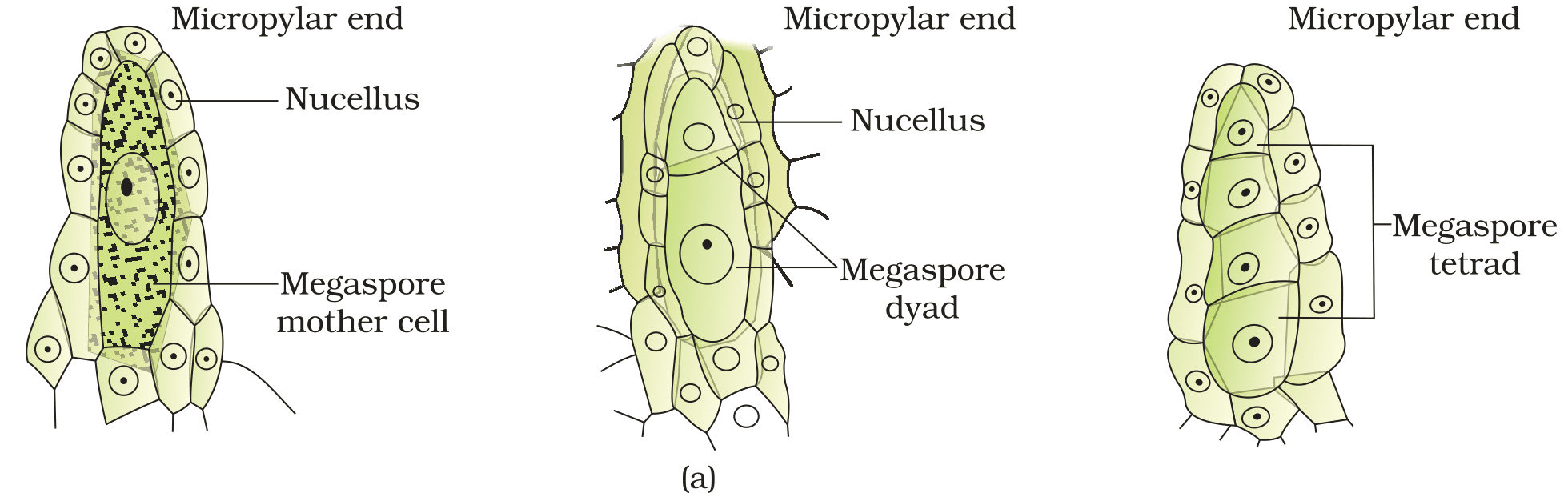
Figure 1.8 (a) Parts of the ovule showing a large megaspore mother cell, a dyad and a tetrad of megaspores