
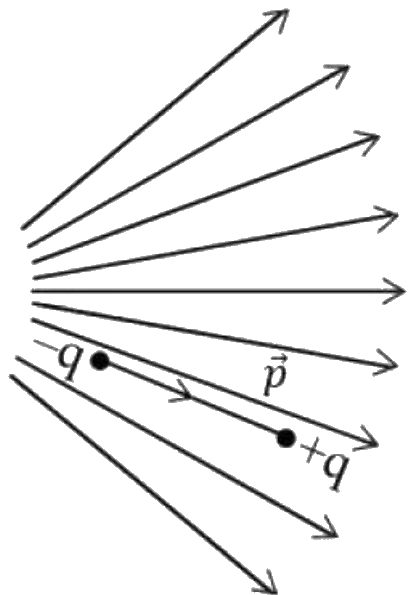
Figure shows electric field lines in which an electric dipole \( \vec{p} \) is placed as shown. Which of the following statements is correct?
Answer & explanation
Correct answer: option 3
The correct answer is Option (3) → The dipole will experience a force opposite to \( \vec{p} \)
In a non-uniform field the forces on the two charges of a dipole are not equal, so there is a net force. The field is stronger where the field lines are closer together.
In the figure the lines spread out from left to right, so the field is stronger at \( -q \) (left) than at \( +q \) (right), and \( \vec{p} \) points along the field (from \( -q \) to \( +q \)).
\( \text{force on } -q:\; qE_{-}\ \text{opposite to } \vec{p} \)
\( \text{force on } +q:\; qE_{+}\ \text{along } \vec{p} \)
Since \( E_{-} \gt E_{+} \), the force on \( -q \) is larger, and the net force on the dipole is opposite to \( \vec{p} \), towards the region of stronger field.
Option (1) The dipole will not experience any force — Incorrect. The net force is zero only in a uniform field; here the field is non-uniform.
Option (2) The dipole will experience a force in the direction of \( \vec{p} \) — Incorrect. The force on \( +q \), along \( \vec{p} \), is the smaller of the two forces.
Option (3) The dipole will experience a force opposite to \( \vec{p} \) — Correct. The larger force acts on \( -q \), opposite to \( \vec{p} \).
Option (4) The dipole will experience a force perpendicular to \( \vec{p} \) — Incorrect. The two forces act along the field at the charges, which runs along the dipole axis, so the net force is along the axis (opposite to \( \vec{p} \)), not perpendicular to it.
NCERT (2026-27):
Dipole in a Uniform External Field – “… What happens if the field is not uniform? In that case, the net force will evidently be non-zero. … It is easily seen that when p is parallel to E, the dipole has a net force in the direction of increasing field.”