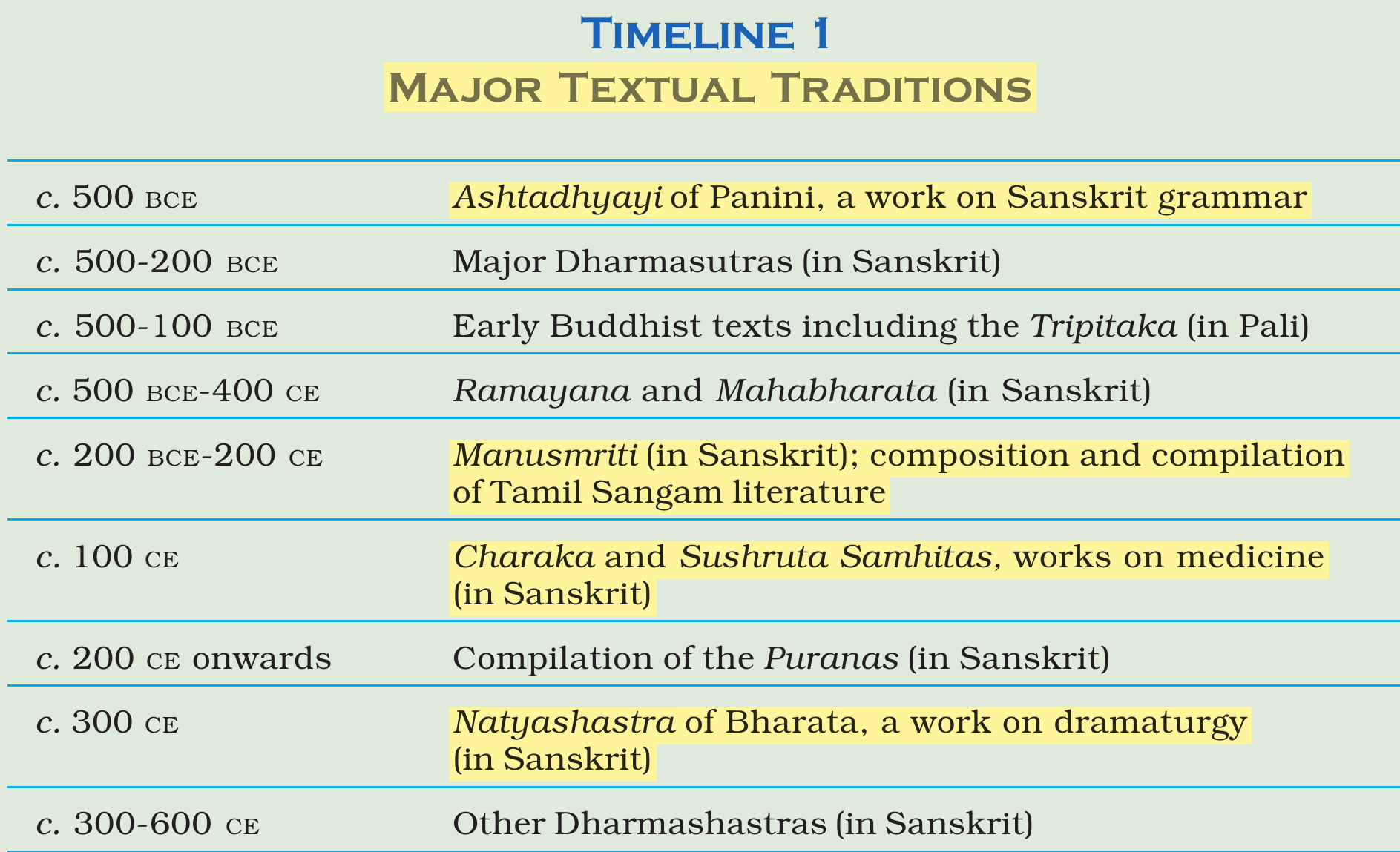
Match List-I with List-II:
| List-I Major Textual Traditions | List-II Year/s of Compilation | ||
| (A) | Ashtadhyayi | (I) | c. 100 CE |
| (B) | Natyashastra | (II) | c. 500 BCE |
| (C) | Charaka and Sushruta Samhitas | (III) | c. 200 BCE-200 CE |
| (D) | Manusmriti | (IV) | c. 300 CE |
Choose the correct answer from the options given below.
Answer & explanation
Correct answer: option 4
The correct answer is Option (4) → (A)-(II), (B)-(IV), (C)-(I), (D)-(III)
(A) Ashtadhyayi — this matches (II) c. 500 BCE. The Ashtadhyayi of Panini is a work on Sanskrit grammar, the earliest of the textual traditions in the chapter’s timeline.
(B) Natyashastra — this matches (IV) c. 300 CE. The Natyashastra of Bharata is a work on dramaturgy, in Sanskrit.
(C) Charaka and Sushruta Samhitas — this matches (I) c. 100 CE. These are works on medicine, in Sanskrit.
(D) Manusmriti — this matches (III) c. 200 BCE-200 CE. The Manusmriti, in Sanskrit, belongs to the same centuries as the composition and compilation of Tamil Sangam literature.
Tip: This question comes straight from the timeline at the end of the chapter. Revise the chapter timelines; NTA takes whole questions from them.
NCERT: Themes in Indian History Part I — Chapter 3: Kinship, Caste and Class (2025-26)
|