CUETMOCK
  • Pricing
  • Mentors
Log inStart freeStart free mocks→

First test, then trust

Try a free CUET mock test.

Join 5,00,000+ students who rehearsed exam day on the exact NTA screen before sitting CUET. On the web and on Android.

Start free mocks →Get the Android app
CUETMOCK

India's #1 CUET Mock Test Platform. Original NCERT-based questions on the exact NTA exam screen — trusted by 5,00,000+ students since CUET 2022.

Get it onGoogle PlayScan to download the CUETMOCK app

Mock tests

  • CUET mock test series
  • Browse all papers
  • Commerce mocks
  • Humanities (Arts) mocks
  • Science mocks
  • Languages & GAT mocks
  • Free practice questions
  • Pricing

Resources

  • CUET exam guide
  • CUET syllabus
  • Universities accepting CUET
  • Expert blogs
  • News & notifications
  • Webinars & counselling
  • CUET score calculator
  • How we estimate your rank
  • FAQs

Company

  • About us
  • Our leadership & team
  • Our toppers
  • Mentors
  • For schools
  • Contact us
  • Terms
  • Privacy
  • Refund policy

Talk to us

+91 7696 6630 56info@cuetmock.comWhatsApp us

Our other platforms

  • JEE Mock — For IIT-JEE aspirants
  • NEET Mock — For NEET aspirants

Newsletter

Exam updates, study material and offers — no spam.

© 2026 NYC Ventures Pvt. Ltd.

701-702, Royal Business Park, Zirakpur, Punjab - 140603

  • Terms of use
  • Privacy policy
  • Refund policy
  • Contact us

iCUETMOCK is an independent preparation platform, not affiliated with the National Testing Agency (NTA). Always check exam details on the official NTA website.

  • Home
  • Mock tests
  • CUET guide
  • Pricing
  • Log in
Home/Practice questions/Accountancy Part B
Accountancy Part BAccounting Ratios

Current ratio is 2.5, current liabilities Rs. 25,000, the amount of c…

Current ratio is 2.5, current liabilities Rs. 25,000, the amount of current assets will be:

Answer & explanation+

Correct answer: option 1

The correct answer is Option (1) → Rs. 62,500

Current Ratio = Current Assets ÷ Current Liabilities, so Current Assets = Current Ratio × Current Liabilities.

  • Current Assets = 2.5 × Rs. 25,000

  • Current Assets = Rs. 62,500

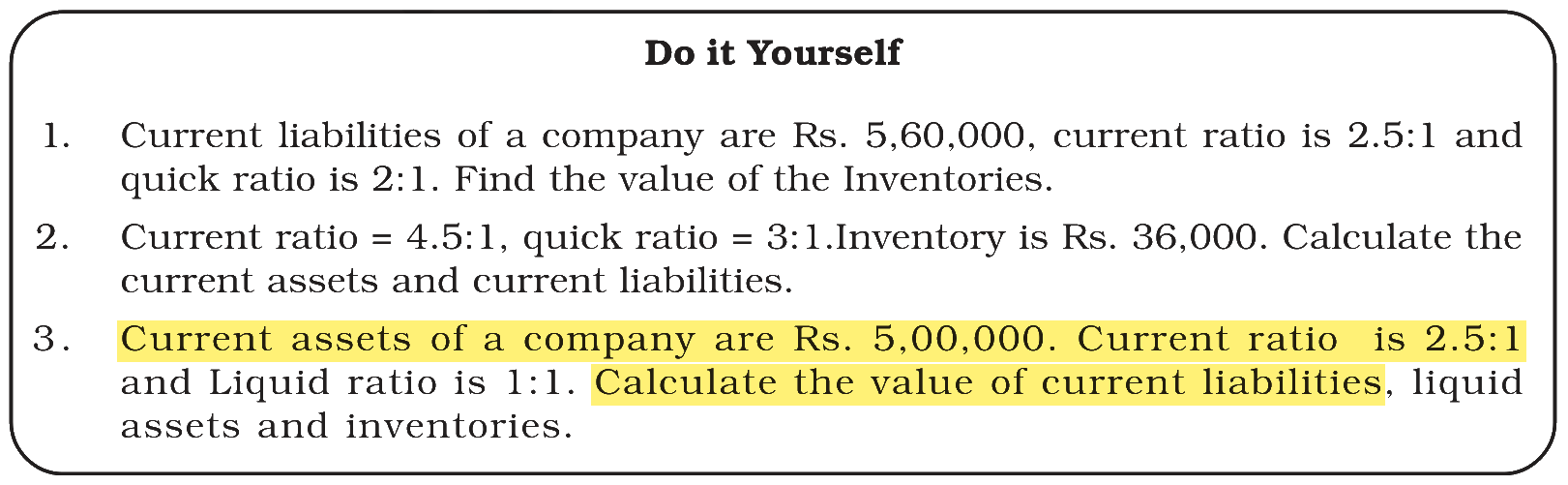
NCERT (2026-27 edition):
Do it Yourself

Extract from the NCERT textbook

Advertisement

Practise more on Accounting Ratios

Chapter-wise mocks on the real NTA exam screen, with solutions and your rank. Your first mocks are free.

Start free mocks →

Advertisement

Next questions

  1. The effective rate that is equivalent to a nominal rate of 6% per annum compounded semi-annually isApplied Maths. Section B2 · Financial Mathematics
  2. Match List-I with List-II(Symbols have their usual meaning)List-IList-II(A) Drift velocity(I) displaystylem/(ne^2ρ) (B) Electrical Resistiv…Physics · Current Electricity
  3. In a photoelectric effect experiment, if the intensity of the incident light of frequency greater than the threshold frequency, is increase…Physics · Dual Nature of Radiation and Matter
  4. Match the LIST-I with LIST-IILIST-ILIST-IITermsExamplesA. Apocarpous pistilI. VallisneriaB. Water pollinationII. PeaC. Parthenocarpic fruit…Biology · Sexual Reproduction in Flowering Plants
  5. If A is a square matrix such that |A|≠ 0 and A^2-A+2I=0 then A^-1 is equal to :(where I is an identity matrix of order as order of matrix A)Maths. Section A · Determinants
  6. The manganese belt in Balaghat-Chhindwara-Nimar-Mandla and Jhabua districts is located in which state in India?General Aptitude Test · General Knowledge
  7. Which of the following missile systems have been successfully inducted and operationalized in India?A. MRSAM-INB. BrahMosC. GaganyaanD. Aka…General Aptitude Test · General Knowledge
  8. Which of the following is used for calculating actual growth of population?Geography · Fundamentals of Human Geography: World Population-Distribution, Density and growth
  9. Which of the following statements were part of the declaration on the Fundamental Rights of Citizenship in India that was made in the Karac…Sociology · Indian Society: Patterns of Social Inequality and Exclusion
  10. In the given figure, ∠1,∠2,∠3 and ∠4, respectively are-A. angle of emergenceB. angle of incidenceC. angle of refractionD. angle of deviatio…Physics · Ray Optics